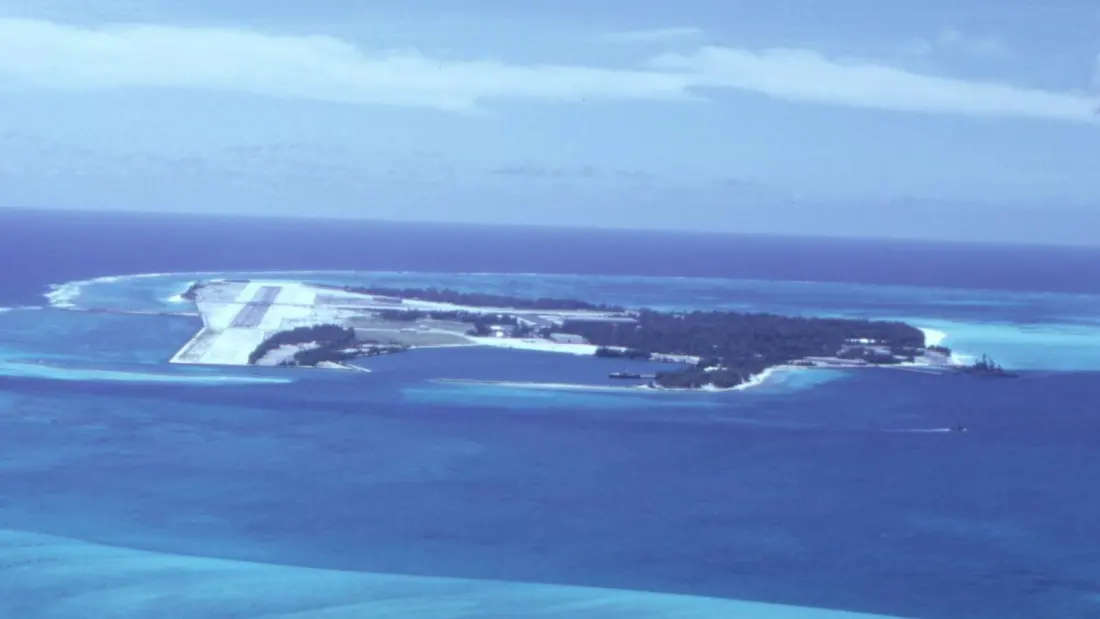
Henderson Field on Midway Atoll handles no scheduled passenger flights — its last regular commercial service ended in 2002. Its runway is deteriorating, and the US Federal Aviation Administration is weighing a repair package of more than $100 million to keep it usable. That may sound like a bureaucratic detail, but the airport is arguably the most important piece of asphalt nobody flies to.
Why? Location. Midway sits roughly a third of the way between Asia and Hawaii, right under the flight paths of transpacific routes between the US mainland, Japan and Australia. Under ETOPS rules, long-haul twin-engine aircraft must always have a suitable diversion airport within reach. For many flights to Honolulu and the US West Coast, Henderson Field is that airport — and the only one for hundreds of miles. Its 7,800-foot runway 06/24 is long enough for widebodies, which matters when an Airbus A330 full of passengers needs somewhere to put down.
The airlines have made their case loudly. Zipair told the FAA that Midway is critical to its operations year-round, especially on summer departures from Los Angeles, San Jose and San Francisco. Japan Airlines relies on it as the primary alternate for almost all of its Honolulu flights. Qantas has flagged that if Midway lost its ETOPS certification, its upcoming ultra-long-haul Project Sunrise services would need rerouting, driving up costs that would likely land on passengers as higher fares.
This is not theoretical. A Hawaiian Airlines A330 diverted to Midway in September 2021 with an oil pressure problem on a Seoul–Honolulu flight, and it was one of at least three such emergencies there in a single decade — a Delta 747-400 in 2011 and a United 777 in 2014, each carrying more than 300 people. Even aviation history has touched down there: a Continental 737 visited in 2008 to mark the 66th anniversary of the Battle of Midway.
The Department of Transportation says the runway could reach severe deterioration within five years, with milling, repaving and seawall repairs needed. Given how rarely the airport is actually used, $100 million might seem steep — but compared with the cost of forcing transpacific flights onto longer, less efficient routes, it looks like cheap insurance.
For travellers, this is one of those stories you only notice when it goes wrong: keep Midway open, and your Tokyo or Sydney flight keeps its fuel-efficient route and a safety net mid-ocean. For the curious, Midway itself is a fascinating footnote — a remote US wildlife refuge, famous for its albatross colonies and WWII history, with a resident population of around 40 people served only by charter flights. Just don't expect to book a connecting flight there.
Story sourced from Simple Flying.