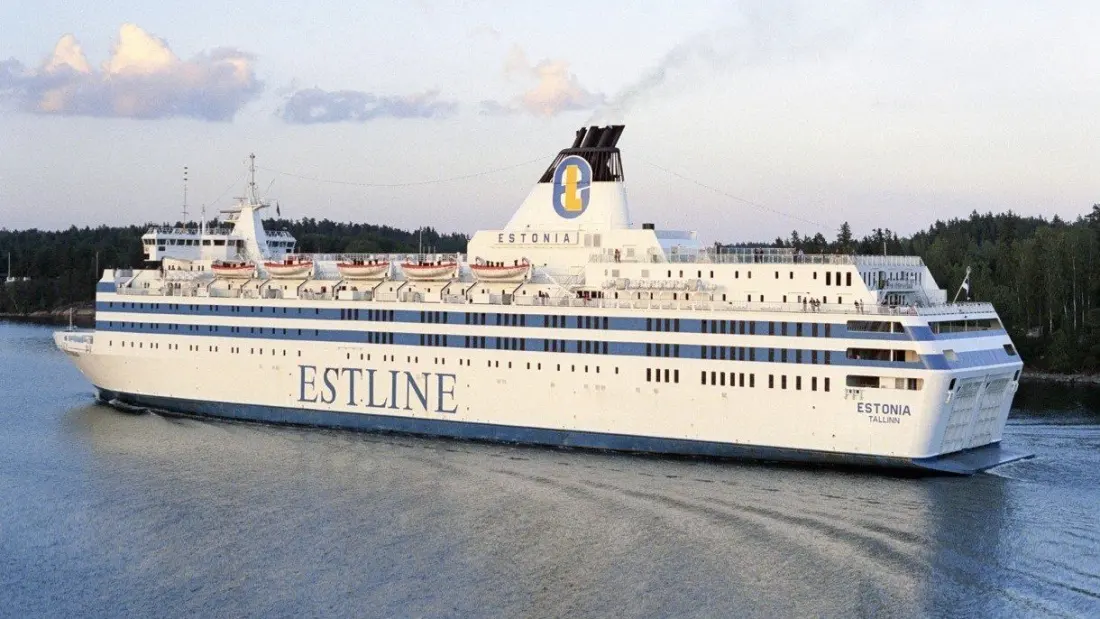
Just after midnight on 28 September 1994, the ferry MS Estonia left Tallinn bound for Stockholm and never made it. In seas that were rough but not unusual for the Baltic, passengers heard a series of heavy bangs through the hull. Within an hour, the ship had gone down. Of everyone aboard, only 137 survived; 852 people died, making it one of Europe's worst peacetime maritime disasters.
The official investigation pinpointed the culprit: the bow visor, a fifty-tonne steel shell at the front of the ship that swung up to reveal the vehicle loading ramp. Held shut by three locks, it was battered loose by waves that night. With the ramp exposed, water flooded onto the car deck — and on a roll-on/roll-off ferry, that's catastrophic. A ro-ro's vast, undivided vehicle deck turns flooding water into a shifting free weight that can strip a ship of stability in minutes. Survivors described a sudden, irreversible list that made stairs and corridors useless.
The Estonia wasn't the first disaster to force maritime rules to change. The Titanic's sinking in 1912 produced the original SOLAS convention on lifeboats and buoyancy. The Herald of Free Enterprise capsizing at Zeebrugge in 1987, with its bow doors open, exposed the specific dangers of car decks and led to stricter SOLAS 90 standards — which were only being codified as the Estonia went down.
The Estonia pushed things further. The 1996 Stockholm Agreement required European ro-ro passenger ferries to meet SOLAS 90 stability standards even with half a metre of water already sloshing on the car deck. According to Kristjan Tabri, a marine technology expert at Tallinn University of Technology, that meant water could no longer spread freely: shipbuilders added bulkheads, watertight partitions and wider hulls called sponsons, while older ferries faced costly retrofits or early retirement.
The other change is hiding in plain sight on every ferry bow. Upward-opening visors have nearly vanished from open-sea routes, because waves strain them open while pressing side-opening doors shut. Today visors survive mainly on short sheltered crossings, like the island ferries in Estonia's own waters.
The story hasn't fully closed. A 2020 Swedish documentary showed imagery suggesting a hole in the hull, reigniting debate about the cause, and 2022 reports claimed Swedish defence forces had carried more military equipment aboard than originally admitted. Investigations continue, and the wreck remains sealed on the Baltic seabed.
For anyone catching a ferry between Tallinn and Helsinki or Stockholm today, this history is more than a memorial — it's the reason modern Baltic crossings are among the safest at sea. Every regulation that makes those sailings routine was written at a terrible price.