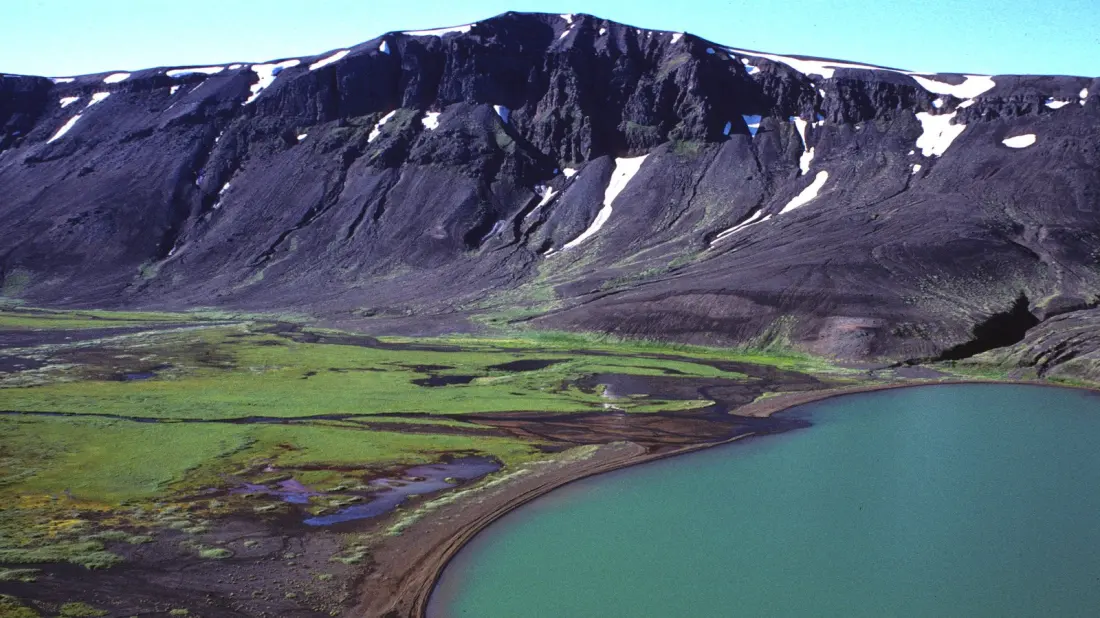
The least-visited unit of the entire U.S. National Park system isn't a subtle secret — it's a volcano. Aniakchak National Monument and Preserve sits on the remote Alaska Peninsula, and it receives a trickle of visitors each year precisely because getting there is genuinely hard. There are no roads, no trails, no campgrounds and no facilities. You fly in, or you don't go.
The park's centrepiece is the Aniakchak Caldera, a six-mile-wide crater left behind when a 7,000-foot volcano exploded around 3,500 years ago. The area is still tectonically alive — the last eruption inside the caldera was in 1931, and the whole region sits on the Pacific Ring of Fire. What you find today is raw volcanic country: lava flows, cinder cones, fumaroles, hot springs and Surprise Lake, which drains into the Aniakchak River. That river punches straight through a gap in the caldera wall and has become a draw for whitewater rafters looking for genuinely wild runs.
Access usually works like this: fly from Anchorage to King Salmon, then continue by small plane or water taxi toward Port Heiden or the monument itself. Floatplanes and fixed-wing aircraft can land within the monument and preserve, but fog, rain and wind frequently delay or cancel flights, so schedules need slack built in. The King Salmon visitor centre is worth a stop — exhibits cover the archaeology of Indigenous communities who have used the caldera for more than 2,000 years.
This is self-sufficient backcountry travel, plain and simple. Summer highs sit only in the high 40s to low 50s Fahrenheit, so layers and waterproofs are non-negotiable, and anyone overnighting should know the early signs of hypothermia. Brown bears are common throughout: carry bear-resistant food containers, store gear properly, and know that playing dead beats running — a brown bear can hit 30 miles per hour. Emergency help can be a long time coming, so this is a trip for experienced backcountry travellers with satellite communication and a solid plan, not a first backpacking trip.
For the right traveller, though, that difficulty is the appeal. Aniakchak offers a national park experience almost nobody else gets: a caldera you may have entirely to yourself, wild rivers, and the feeling of standing in a landscape still being shaped by the forces that made it.