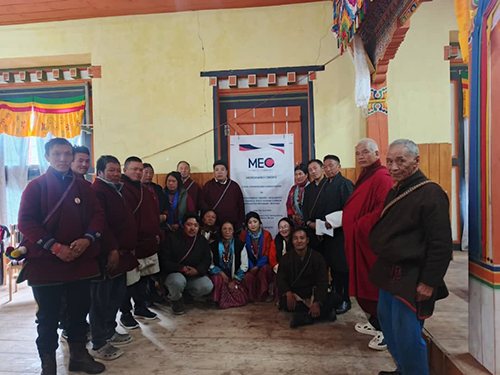
High in the Himalayas, winter still means a bukhari: a cast-iron wood stove that heats the room and boils the kettle, fuelled by truckloads of oak or pine. That could be changing. The Bhutan Ecological Society (BES), working with US-based MicroEnergy Credits under the Bhutan-Singapore Carbon framework, is rolling out one of the country's biggest domestic clean energy programmes — a plan to put 100,000 high-efficiency electric cookstoves and space heaters into rural and low-income homes over five years.
The pilot launched across six dzongkhags with 300 units, split evenly between cookstoves and heaters. Both run at roughly 90 percent efficiency, a huge jump from traditional stoves, which waste most of their fuel's energy — only 10–15 percent becomes useful heat. Induction and infrared cookstoves, by contrast, convert 80–90 percent. And because Bhutan's grid is almost entirely hydropowered, the switch slashes emissions: household LPG alone releases about 27,000 tonnes of CO₂ a year in Bhutan.
The numbers behind the problem are striking. Bhutan burned around 254,600 tonnes of fuelwood in 2022, nearly 200,000 tonnes of it in homes — for cooking, heating, hot-stone baths and rituals. Biomass still supplies about a quarter of the country's energy and 63 percent of energy used in buildings. On top of that, every kilogram of LPG is imported, with households using some 9,200 tonnes in 2022, plus 950 kilolitres of kerosene, mostly for heating.
For families, the savings matter as much as the carbon maths. In cold spots like Dogar in Paro, a truckload of oak hardwood can cost up to Nu 8,000, pine around Nu 6,000, and an LPG cylinder Nu 1,700–1,800 — and winters in the colder dzongkhags stretch seven to eight months. Under the programme, BES covers 80 percent of the cost and households pay the rest, with carbon finance funding training, repairs and after-sales service. Early feedback has been strong: beneficiaries report the e-cookstoves cook well and take pressure off expensive LPG cylinders.
Scaling up will mean convincing people, not just supplying kit. Coordinators are fielding concerns about taste, safety and electricity bills — early monitoring shows no worrying bill spikes, and the pilot includes a one-year warranty on glass parts plus free coil repairs. Pending approval from the Department of Environment and Climate Change, the plan expands to all 20 dzongkhags.
Why should travellers care? If you're heading to a Bhutanese farmhouse homestay or trekking lodge, this shift touches your experience directly: cleaner indoor air where you sleep, less smoke haze in valleys, and less strain on the forests that make Bhutan one of the world's few carbon-negative countries. It's also a rare chance to see carbon-market money doing something tangible at village level — a story worth asking your hosts about.