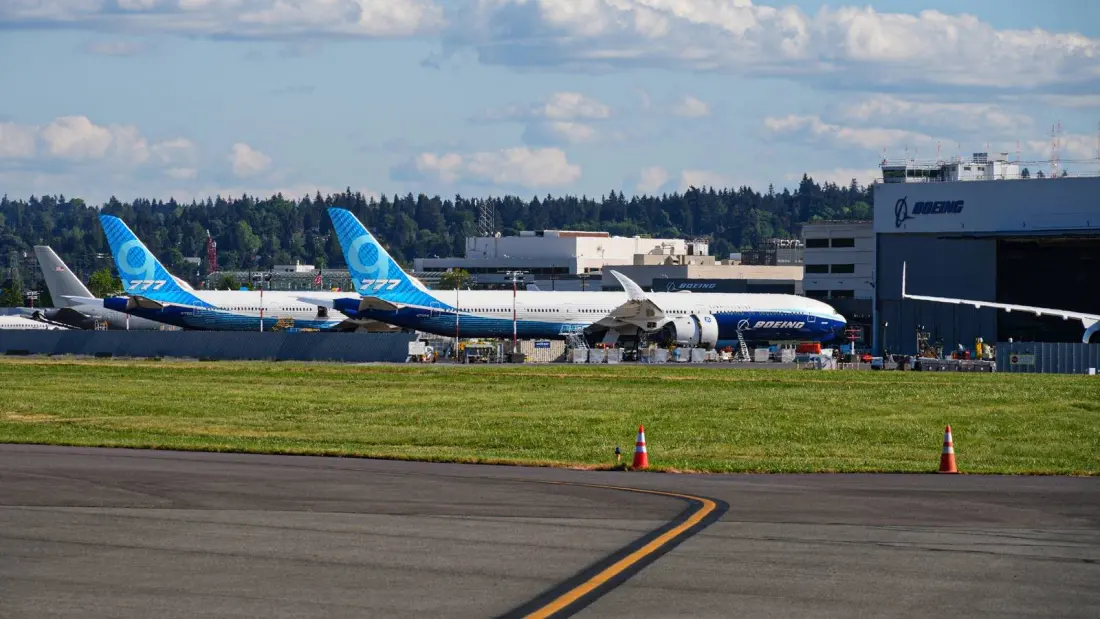
Boeing has taken apart a Boeing 777X that never got the chance to fly. The jet, known as WH007, was the seventh 777-9 built and had sat idle at the company's Everett, Washington factory since rolling out in summer 2019, complete with Emirates branding on its folding wingtips and weighted blocks standing in for engines. By late summer 2025, Boeing confirmed it had scrapped the "partially assembled" airframe rather than pay to bring it up to the current design standard.
The reason is simple maths. The 777X program launched at the 2013 Dubai Airshow with a record 259 orders worth $95 billion, targeting a 2020 commercial debut. Certification is now not expected until 2027, with first deliveries pushed to next year. In that time, Boeing has built around 30 airframes that are waiting on the tarmac — some dating back to 2019 — and each one needs "change incorporation": essentially a rebuild to match more than half a decade of design revisions discovered during testing.
The retrofit bill is enormous. Boeing booked another $4.9 billion in charges in its October 2025 results, pushing total 777X charges past $15 billion. That figure covers prolonged testing, compensation owed to airlines for late deliveries, and the retrofits themselves. CEO Kelly Ortberg has said the work scales with an aircraft's age, and for WH007 the effort clearly outweighed any value in finishing it. The program's setbacks read like a catalogue: a cargo door blowing out during a 2019 ground test, GE9X engine compressor troubles, uncommanded pitch events in flight testing, cracked engine thrust links grounding the test fleet in 2024, and more recent engine seal durability concerns.
For travellers, the stakes are real. The 777X family — the 777-8, 777-9 and 777-8F freighter — promises to be the largest twin-engine jet flying, with the 777-9 seating up to 450 in two classes and the 777-8 reaching 9,500 nautical miles. Emirates remains the anchor customer with 321 on order, followed by Qatar Airways with 124, plus Lufthansa, Singapore Airlines, Cathay Pacific and British Airways. Anyone hoping to fly the new flagship on routes to the Gulf, Asia or long-haul Europe should temper expectations: seven-plus years after original plans, the aircraft is still years away from regular passenger service.
The order book has grown to 730 jets despite the delays, which tells you airlines still want the aircraft. But the decision to scrap one before it ever flew shows the scale of what remains: Boeing must now strip down and update roughly 30 pre-built airframes, a process expected to take years. If you're booking a long-haul trip in the next few years, plan around the aircraft flying today — the 777X will arrive, just later than anyone expected.