
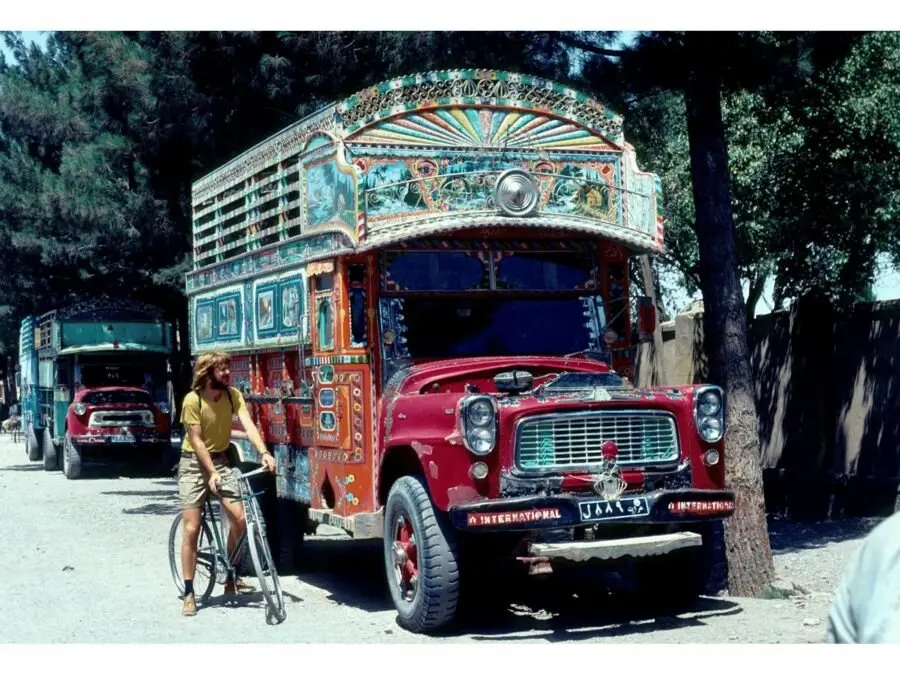
Long before he became America's best-known guidebook writer, a 23-year-old Rick Steves rode the Hippie Trail from Istanbul to Kathmandu. He's now publishing excerpts from his 1978 travel journal, and the latest entry is a vivid day-by-day portrait of Herat, Afghanistan — a country he revisits in print following the 2021 Taliban takeover.
The day in question, Monday 31 July 1978, started with rental bicycles that cost a dollar each for two hours. Steves and his companion pedalled to the ruined minarets on the city's edge, where an old man let them into a mosque for 10 afghanis to see the tomb of an Afghan king. From there the ride drifted into quieter, walled mud-brick lanes on the town's outskirts, where locals were so unaccustomed to visitors that the pair felt like a genuine curiosity. Steves writes that Afghanistan struck him as one of the friendliest countries he'd ever travelled through — people shook his hand "as equals", though he also notes that any woman past puberty on the streets was fully veiled, seeing only through a small cloth grid.
The afternoon belonged to Herat's endless bazaar, where every five yards brought a new craft neighbourhood: water-pipe makers, tin pounders, weavers, bead stringers, knife sharpeners on foot-powered wheels, nail benders. All hand work, all day, all working life — a sight that made the young piano teacher vow never to complain about his own job again. Shopping was absurdly cheap by today's standards: he eventually bargained a mink skin down to 460 afghanis, about $12, and bought small trinkets for five afghanis (roughly a cent).
Transport was part of the adventure too — a three-wheeled taxi he compares to a souped-up ice-cream truck, then a horse-drawn buggy, which the pair paid off with a confident 10 afghanis. His pricing tip: agree the fare upfront and you'll be sized up as a rookie; hop on, pay what seems fair afterwards, and you'll do fine. Between outings there were swims in the hotel pool in their underwear, hearty meat dinners with tea and melon, evenings photographing lantern-lit portraits, and a memorable rooftop moment watching torch-carrying chariots pass as the sun dropped behind the mountains.
Why does this matter to travellers now? Partly as nostalgia for a route that simply no longer exists — the overland trail through Iran and Afghanistan closed off decades before the current regime, and independent travel there today is effectively off the table for ordinary tourists. But it's also a window into how travel writing begins, and a reminder that the places we can't visit still have stories worth reading. It's a piece for armchair travellers, overlanding romantics and anyone curious about the region beyond headlines. Steves says two more journal entries are coming, including a 500-mile ride across Afghanistan and a look at 1978 Kabul.