
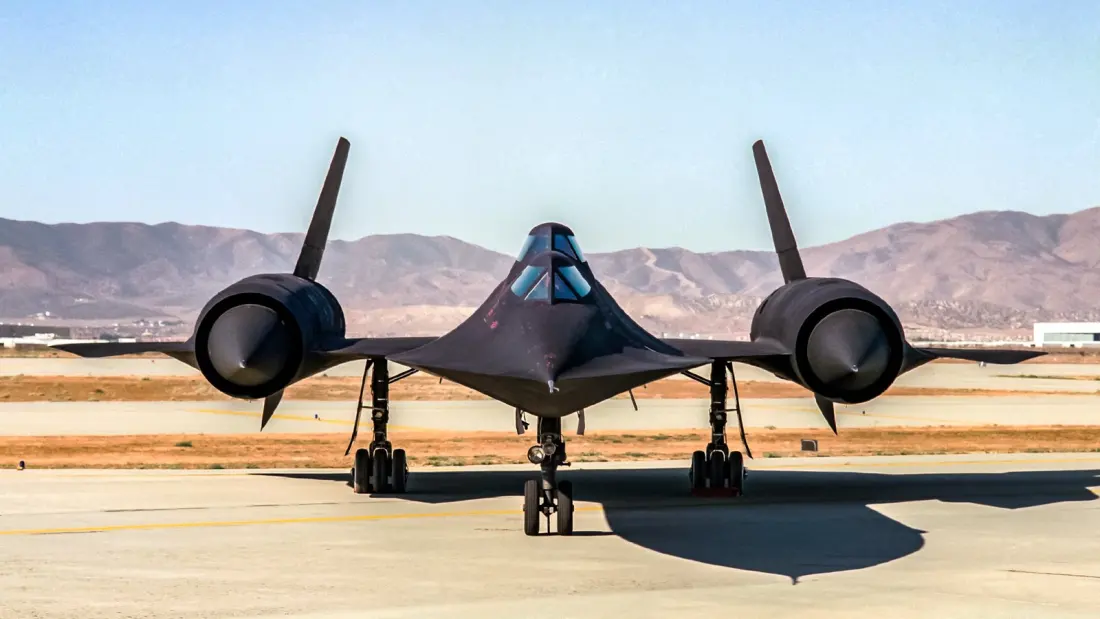
One of the strangest engineering mysteries of the Cold War wasn't solved in a lab or a wind tunnel — it was solved at the tap. During the development of Lockheed's SR-71 Blackbird, engineers at the famous Skunk Works facility in Burbank, California, noticed something baffling: titanium wing panels that were spot-welded during summer kept failing, some within just six or seven weeks, while identical panels made in winter lasted indefinitely.
The clue that cracked the case had nothing to do with aviation. Burbank's municipal water system was dosed with extra chlorine each summer to control algae. That same water was used to rinse titanium panels after acid treatment, and the chlorine was quietly triggering stress corrosion in the metal. Kelly Johnson's own account records that switching to distilled water for washing the parts fixed the problem for good. For an aircraft designed to cruise at Mach 3 and 78,000 feet, the biggest threat turned out to be the local water supply.
The Blackbird's dependence on titanium made it uniquely fragile in this way. Aluminium couldn't survive the heat of sustained Mach 3 flight, so Lockheed built the airframe from titanium — a material so scarce in the US that much of it was secretly imported from the USSR through third countries. Skunk Works ended up producing over 13 million titanium parts, and crucially kept records tracing most of them back to the original mill pour, including grain direction for roughly the last 10 million. That obsessive paperwork is what let engineers spot the seasonal failure pattern in the first place.
Water wasn't the only everyday hazard. Cadmium-plated wrenches, standard kit in any workshop, left trace cadmium on bolt heads. When those components heated past 600°F (315°C) in flight, the bolts could simply drop off. The fix: hundreds of toolboxes purged of cadmium-plated tools. Even cutting fluids came under suspicion, with commercial versions found to accelerate stress corrosion, prompting Skunk Works to develop its own.
For travellers, the story adds a layer to any visit to the Los Angeles area. Burbank — better known today as a media-industry hub and a convenient alternative gateway to LAX — was home to one of the most remarkable engineering operations in history. Aviation fans can pair a Burbank stop with the air museums around LA, including the California Science Center and the Planes of Fame Air Museum in nearby Chino, and consider how much invisible problem-solving sits behind the jets on display. The Blackbird's lesson endures: sometimes the difference between success and failure at 2,000 mph is a chemical in the rinse water.
Full credit for the historical detail to Simple Flying.