
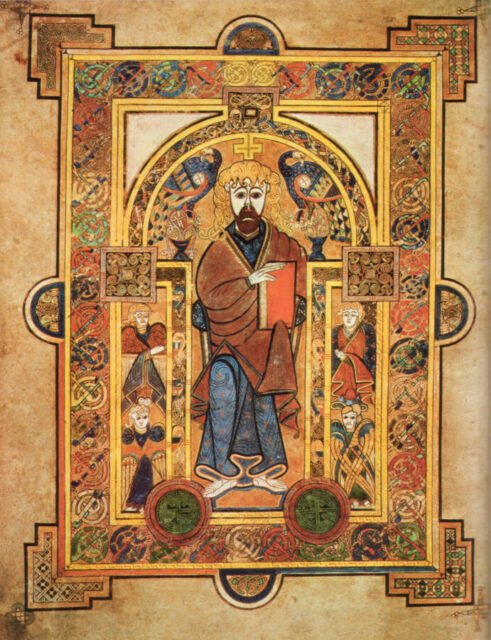
One of the most remarkable artworks to survive from Europe's so-called Dark Ages isn't in a gallery — it's a single vellum page of a gospel book you can see in Dublin. The Book of Kells, a 1,200-year-old illuminated manuscript, contains a portrait known as Christ Enthroned: Jesus seated stiffly under an arch, curly flaxen hair, holding the holy word of God, surrounded by a dense maze of spirals, swirls and intertwined snakes rendered in vivid blue, purple, red, green, yellow and black.
The story behind it is dramatic. Around the year 800, with the Roman Empire long collapsed and Viking raids tearing through Europe, a community of scholarly Irish monks set out to preserve the gospels. They slaughtered 185 calves and dried the skins into 680 cream-coloured vellum pages, then wrote out the Latin text with swan-quill pens, decorating nearly every page — only two of the 680 have no ornament at all.
The work was violently interrupted. In 806, Vikings raided the original monastery and killed 68 monks. The survivors fled to the Abbey of Kells, near Dublin, where they finished the book that now bears the town's name.
Christ Enthroned marks the moment in Matthew 1:18 where the divine Christ is about to be born as a mortal. Look closely and the detail-work rewards you: two mysterious robed figures flank Christ, two oddly grotesque angels sit with folded wings, and peacocks — symbols of the resurrection — stand with feet tangled in vines representing Christ's Israelite roots. Christ himself is far from realistic, posed like a Byzantine icon with almond eyes, oddly placed ears and spindly fingers. The real magic is the ornamentation: pagan Celtic circles, spirals and knotwork woven together with Christian symbols, all etched with a quill.
Why does this matter to a traveller? Because the Book of Kells is arguably the finest surviving artwork of its era, and it's displayed in Dublin, where it has been since the 1660s — Trinity College exhibits it to the public, and thousands queue daily for a look. It's also a rare window into a fragile moment when a handful of monks on Europe's edge were keeping literacy and learning alive. When Gutenberg's printing press arrived in 1455, books like this became history; seeing one in person is a completely different experience from any reproduction. Pair it with Trinity's Long Room library and a day trip to Kells itself, and you've got one of Ireland's most rewarding cultural outings.