
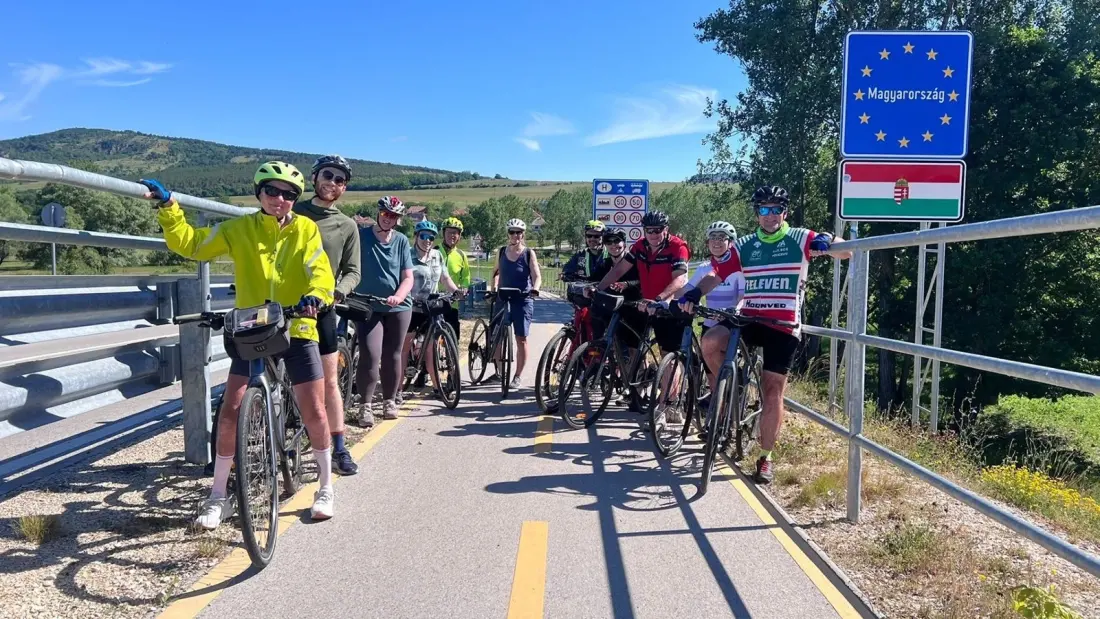
Jennifer Mazerolle arrived in Vienna to start an eight-day cycling trip along the Danube with one big question: how would a legally blind traveller handle city traffic, tram lines and a week on two wheels? The answer, it turned out, was a support van, a flexible guide and a lot of honest conversation.
Jennifer, from Nova Scotia, Canada, has Stargardt disease, a genetic condition causing progressive central vision loss. Diagnosed at nine, she can still make out lights, shapes, colours and people – just not fine detail. Riding a bike wasn't new to her: at home she and her husband Gilles use helmet intercoms, with Gilles riding ahead and calling out bumps, pedestrians and turns.
Her worries about Vienna's chaotic old streets were solved on day one. Trip leader Gabor arranged for her to skip the urban riding and travel by van with driver Ivan to the trailhead each day, where she'd join the group. She rode an e-bike and got a full briefing before every ride – surfaces, distances, hazards – with daily check-ins to make sure she was comfortable. The route ran from Vienna to Bratislava and on to Budapest, through open fields and woodland she describes as the trip's highlight: nature and exercise, the two things she knows keep her mental health in good shape.
Off the bike, the trip had its own pleasures. She rates the Vollpension Cafe in Vienna – staffed entirely by senior citizens – as a favourite stop, and the group of 11 travellers from Canada, the UK and Australia still chat on WhatsApp. Budapest's ruin bars got a visit too.
Jennifer has form for this kind of thing: solo travel in China, hiking in Thailand (including a nerve-wracking log crossing over a river), trips to Costa Rica and Puerto Rico, where she and two legally blind friends famously tried to enter a coffee shop through a window exactly the same size as the door.
What makes this story useful beyond the anecdotes is her practical advice. She booked months ahead and worked through the itinerary with the operator in advance – explaining what she could already do at home and what adaptations would help. Her message to anyone hesitant about a group trip, for any reason: read the itinerary closely, call the company early, and describe the systems that already work for you. And she'd rather skip the word "inspiring" altogether. She's not doing anything extraordinary, she says – just getting out there and living life, white cane and all.
For travellers with disabilities, or anyone who assumes a cycling trip through Europe is out of reach, Jennifer's Danube ride is proof that "possible" and "enjoyable" can both be true – with the right planning and a leader willing to listen.