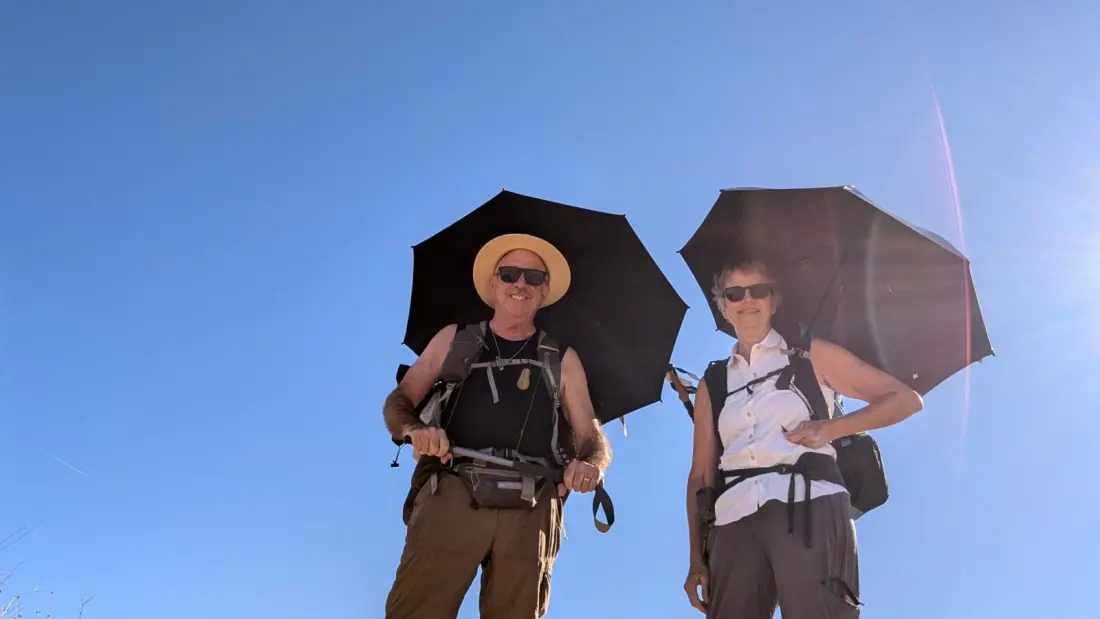
Somewhere on the flat farm tracks of northern Spain, two walkers are renegotiating their daily mileage downward — from 15-plus miles to, well, less. It's one of the more honest moments in a two-day stretch of the Camino de Santiago that runs through Ledigos and ends in Sahagún, and it captures what the pilgrimage actually feels like once the initial party of day one fades and strangers scatter back into solitary walkers.
The days themselves are simple: quiet dirt and gravel paths off the main road, sunrise lighting up the treetops from behind, a palomar (a round brick dovecote once used for raising pigeons and harvesting fertilizer) with doves still swirling in and out of it, and a church in Ledigos where priests are holding Latin Mass to an empty room. In Ledigos, a 45-minute sunflower-oil massage at La Morena Hostel proves the trail's unofficial recovery infrastructure is alive and well.
The destination that matters is Sahagún, where the walkers score a private room with its own bathroom at a working Benedictine monastery staffed by volunteers and a priest. The monastery runs the kind of rhythm you'd expect: an 8 p.m. Mass with a pilgrim's blessing, Compline sung by nuns, then the Grand Silence until morning. For travellers who want something genuinely different from a hostel bunk, this is it — a night inside a living religious community for a donation rather than a booking-site price tag.
But the emotional core of these two days happens at the Santa Cruz Pilgrim Hostel, which hosts a 5 p.m. pilgrims' welcome. The icebreaker — pick a card, explain why — is really a device for getting people to articulate their reason for walking. And it surfaces a distinction the author keeps returning to: "tourist" pilgrims versus "real" ones. One man ended up on the Camino after going out to buy a quart of milk. A woman is walking in place of her sister, who has late-stage cancer. When someone jokes about sending the milk man home, he whispers: "It's not that simple."
The author's own card is a feather — one gray feather has appeared every day since the start — and the facilitator's question ("What do you think it means?") draws out an answer worth stealing for any long walk: pay attention, something more is happening than you're currently aware of.
Why does any of this matter to a traveller? Because the Camino is often sold as a hiking challenge or a box-ticking route, and these two days show the other thing it is: an exercise in carrying less. The walkers, mid-downsize on their own house, conclude it's easy to love people when everything you own fits on your back. Whether you come for the spiritual pull, the monastery beds, or the clam and white bean soup at a village restaurant afterwards, the route through Sahagún rewards slowing down — even if you never work out what the feathers mean.