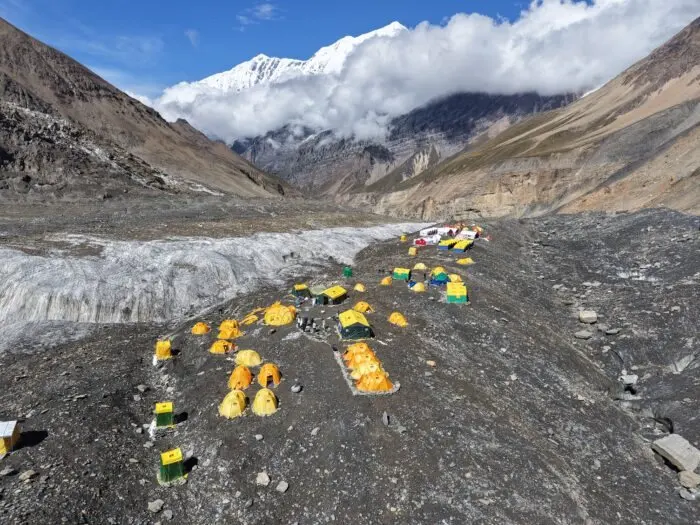
Nepal's autumn climbing season has hit a weather wall. On Dhaulagiri, the world's seventh-highest peak at 8,167m, teams have pulled back to Base Camp as a cyclone approaches, but unlike the recent Manaslu shutdown — where local outfitters closed the mountain amid poor conditions — the climbers here intend to wait it out and try again.
Around 20 foreign climbers and roughly 35 Sherpas have made it onto the mountain so far, out of 34 foreigners holding permits. The rope-fixing effort, coordinated by "Makalu" Lakpa Sherpa of 14 Peaks Expeditions on behalf of all operators, had reached Camp 2 before evening snowfalls coated every altitude in fresh snow. The original plan was ambitious: fix lines fast and push for the summit midweek before the weather broke. Instead, Sherpas retreated, spending their last calm day ferrying equipment down from Camps 1 and 2 before it gets buried.
From September 29, the team will reassess forecasts and decide whether the route can safely reopen. Most commercial clients will be flown out to Pokhara or Kathmandu to sit out the storm, but not everyone is leaving. Australian Paul Clarke and his Hungarian climbing partner Xenia Santha are staying put at Base Camp, where 8K Expeditions provides their logistics.
The pair are attempting Dhaulagiri without supplemental oxygen — a much tougher proposition, and one where the forced pause might actually help. Clarke, who has summited five other 8,000ers, and Santha arrived well prepared: they acclimatised on Khan Tengri in Kyrgyzstan, nearly 7,000m, then trekked to Base Camp over 5,400m French Pass rather than flying in. Crucially, they hadn't yet managed a full rotation on Dhaulagiri itself because of unstable conditions. A rushed summit push this week would have forced them onto oxygen. If the storm clears with enough runway left, they may now get time for a proper acclimatisation rotation first.
Much hinges on the cyclone. As Clarke put it from Base Camp, everything depends on how much snow falls, how stable the mountain is afterwards, and whether the route can be safely reopened. Dhaulagiri is a serious, committing mountain — far less trafficked than Everest or Manaslu — and post-cyclone avalanche risk will be the deciding factor.
For travellers, this is a window into how Himalayan expeditions actually make decisions: weather models, shared rope-fixing teams, airlifts, and calculated patience. And for trekkers eyeing the region, the Annapurna-side trails around Dhaulagiri and the French Pass route Clarke and Santha walked remain among Nepal's most spectacular high-altitude journeys once conditions settle.