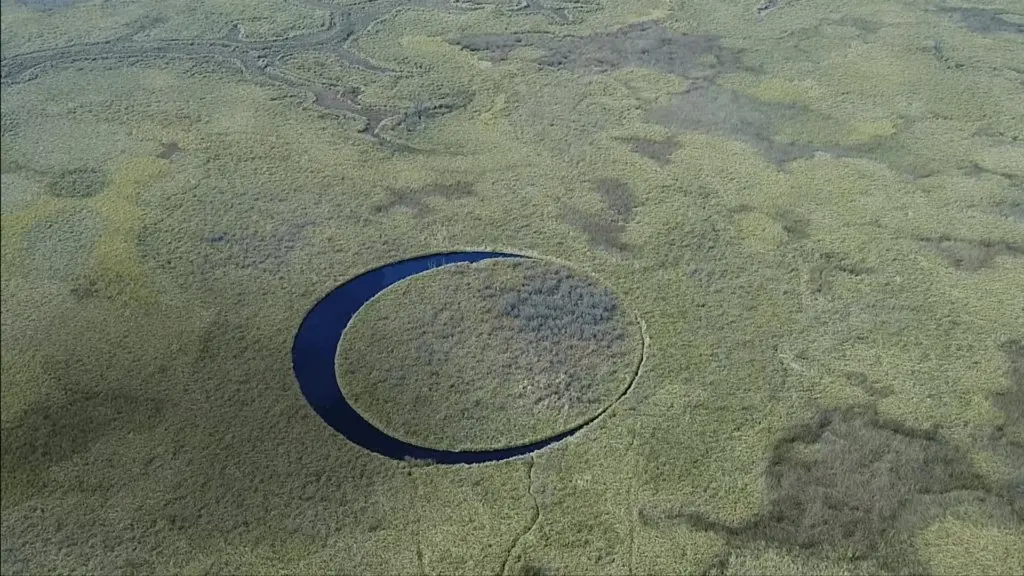
Deep in the Paraná Delta, a few hours north of Buenos Aires, there's a patch of green that shouldn't exist. It's called El Ojo — 'the Eye' — and from above it's almost perfectly circular: a round island floating inside a round pool of dark water, like something drawn with a compass rather than shaped by a river.
The island is uninhabited and roughly 118 metres across. What makes it genuinely strange is that it doesn't stay put. Satellite imagery shows its position has shifted over the years, and it even appears to rotate slowly within its surrounding channel of water.
The wider world only learned about it in 2016, when Argentine filmmaker Sergio Neuspiller spotted the formation on Google Earth while researching a project on delta oddities. Older satellite images confirmed the island had moved — so he organised an expedition to find it. That proved harder than expected: the delta is a dense maze of channels and vegetation, and the first attempt failed. A later trip succeeded, and the team reached El Ojo on foot.
Cue the wild theories — aliens, supernatural forces, the usual. There's no scientific evidence for any of that. The likely explanation is mundane but still fascinating: El Ojo is a floating raft of vegetation, roots and organic debris rather than land anchored to a riverbed. If it drifts within its circular pool, currents would erode and smooth its edges over time, which could explain the uncanny roundness. The Paraná Delta is a landscape in constant flux anyway — water, sediment and plants endlessly reshaping islands and channels — so El Ojo may just be the most photogenic example of those processes at work.
How or exactly when it formed remains unknown. Satellite images show it existed by at least 2003, but that's about as far as the record goes. Honestly, the gaps in the story are part of the appeal.
For travellers, the catch is practical: El Ojo's geometry is invisible from ground level, where it would just look like another lump of delta vegetation. The Eye shape only reads from the air. It sits in a remote, hard-to-navigate stretch of wetlands, and there's no established tourist infrastructure around it — this is a place for scenic-flight photographers, drone enthusiasts and delta boat trips rather than a tick-box stop on an itinerary. Anyone fascinated by it can still enjoy the broader Paraná Delta region, especially the river town of Tigre just outside Buenos Aires, with its boat networks, islands and waterborne way of life.
There's also something quietly relatable about how it was found: someone zooming around a map, noticed a green circle that didn't quite make sense, and decided to go and look. In an era where nearly everything has been photographed and explained, a rotating island in Argentine wetlands is a rare thing — a genuine reason to stop scrolling.
Story via Getaway South Africa