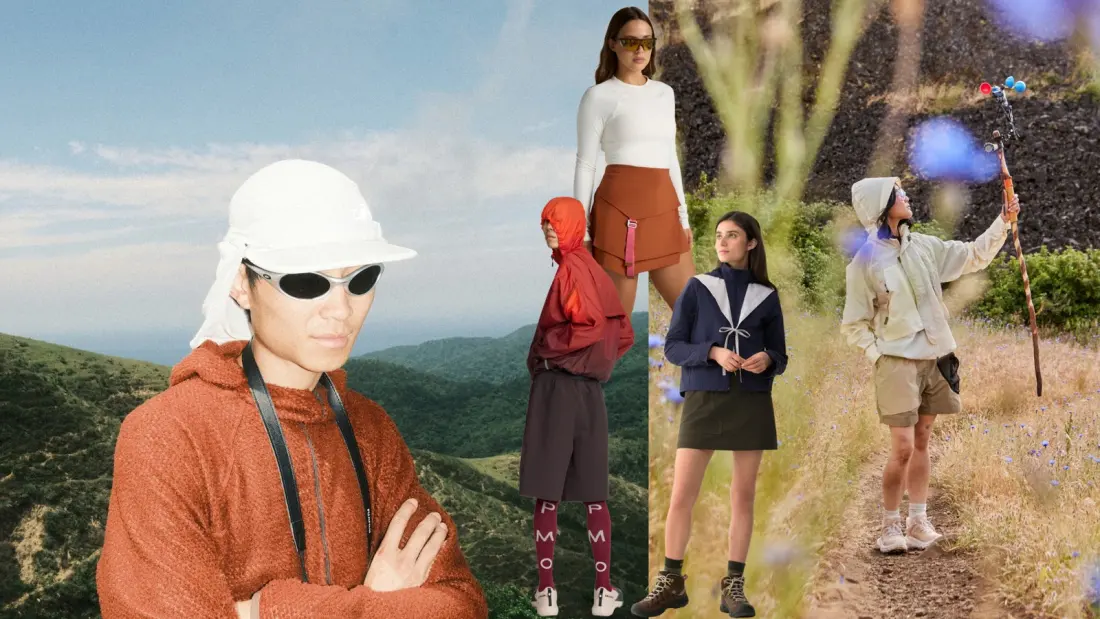
The standard hiking look — blocky boots, khaki nylon pants, pilling fleece, a stiff shell in clashing colours — has barely moved on since the 1980s, when brands like Patagonia, The North Face and REI set a function-first template that treated aesthetics as irrelevant. A new wave of designers with fashion-world credentials is now challenging that, arguing technical gear can look good and perform at the same time.
The most eye-catching example is Gnuhr, founded in 2023 by Nur Abbas, a designer with stints at Louis Vuitton, Maison Margiela and Yeezy behind him. His studio runs a "print farm" of fourteen 3D printers producing camp sandals that weigh just three ounces — some translucent, some glow-in-the-dark — sold for $69. Rather than showing at Paris Fashion Week, Abbas debuted the brand at Pacific Crest Trail Days in Cascade Locks, Oregon, putting it directly in front of the thru-hiking crowd.
He is not alone. Hikerkind, founded in 2021 by New York stylists Chelsea Rizzo and Allison Levy, makes understated performance womenswear. Purple Mountain Observatory pulls from streetwear and global references, Portal mixes contemporary menswear with mountain function, and Earth\Studies blends technical workwear with everyday clothing. What unites them is less a shared look than a shared idea: gear should express identity, not erase it.
The shift matters especially for women, who made up 51.9% of outdoor participants as of 2023 after a pandemic-era boom in outdoor activity. For years the industry offered little beyond the "shrink it and pink it" approach — smaller cuts, brighter colours. Seniq's Valentina Thompson, whose brand opts for high-vis pink over earth tones, sums up the old frustration plainly: the worst part of getting outdoors used to be getting dressed. Now the message is that you can wear your jewellery, keep the makeup on, knot a vintage scarf as a bandana and still be taken seriously on the trail.
The crossover runs both ways. Fashion has been mining technical apparel for inspiration ever since gorpcore made outdoor kit a streetwear staple, and ultralight hiking is now feeding materials innovation back into the mainstream. Think Polartec Alpha Direct insulation, single-panel warp-knit garments and Aluula composites stronger than Dyneema. Legacy brands are catching up slowly — Mountain Hardwear only recently launched its own white backpack, a look Hyperlite pioneered — while small labels experiment with low minimum runs and direct mill sourcing.
For travellers, this means the wall between trail gear and everyday wardrobe is genuinely breaking down. The same pieces that survive a week of backpacking now pass in a city or a gallery, so packing light for mixed itineraries has never been easier. And as trend forecaster Jeanine Pesce puts it, there is no longer a single outdoor uniform — just a collection of archetypes you can mix freely. Hike in it, wear it to dinner, or do both on the same day. That is the whole point.
Outside Online