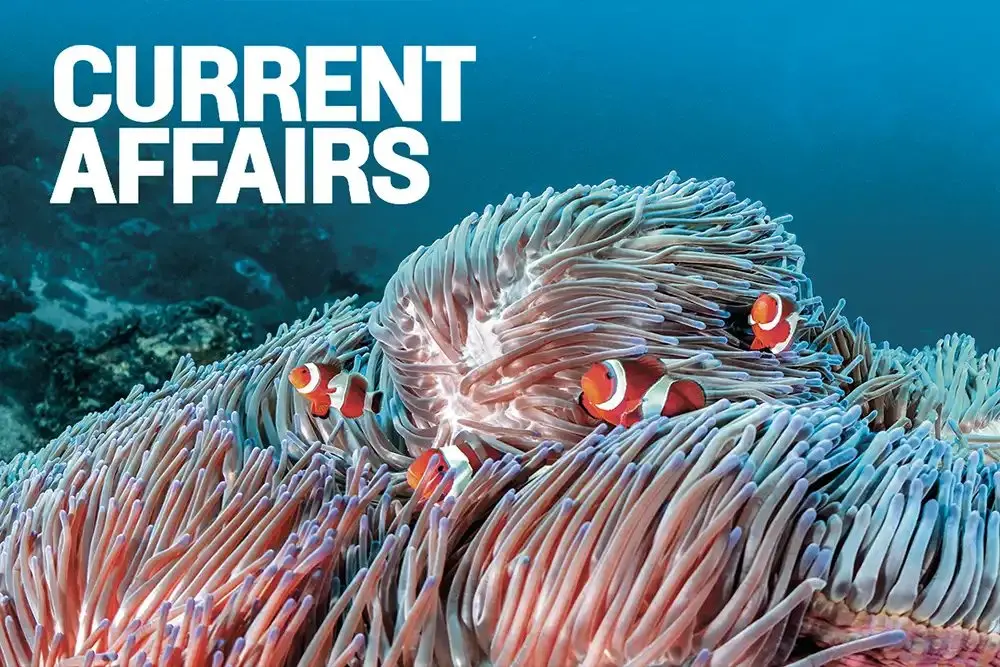
Komodo National Park doesn't do gentle. Wedged between the Indian and Pacific Oceans, this UNESCO World Heritage Site is a choke point where enormous volumes of water get squeezed through narrow straits several times a day, creating some of the fiercest dive conditions anywhere. It's also, thanks to all that nutrient-rich churn, one of the most biodiverse corners of the Coral Triangle — which is exactly why divers keep coming.
A recent trip aboard the liveaboard Komodo Aggressor shows what a week here actually looks like: four dives a day, each timed to the tide, with briefings that matter. Sites range from Mawan, a shallow manta cleaning station on the park's calmer side, to Police Corner near Siaba Besar, where you make a negative entry and ride a brisk current down to a wall at 20 metres. Night dives turn up the small stuff — seahorses, squat lobsters, and in this case a wunderpus emerging from the sand.
Further south, Horseshoe Bay on Rinca Island offers shelter from the open ocean, and Pelican Rock delivers exceptional visibility and a riot of feather stars and barrel sponges in fluorescent reds and oranges. The currents can close the bay's mouth entirely, so good timing and a bit of luck count for a lot.
Then there are the mantas. They're everywhere in Komodo but never guaranteed — at the famous Manta Alley, two dives produced only a pair of drive-bys. Taka Makassar made up for it: a pair of mantas circling a cleaning station attended not by the usual wrasse but by dozens of Klein's butterflyfish, an unusual sight.
Komodo's other celebrities live on land. The park's dragons — the world's largest lizards, growing up to 3 metres — are endemic to Komodo, Rinca, Nusa Kode and Gili Motang, plus nearby Flores. The Aggressor arranges a ranger-led trek into Komodo's savannah, where dragons were found basking in the morning sun. It's a fitting counterpoint to the manta dives: slow, prehistoric, and oddly connected to the same currents that feed the reef.
The finale is Tatawa Kecil, a seamount in Linta Strait notorious for currents that rip in every direction at once. Divers drop in fast, find the eddy where the current splits, and hover above a plateau swarming with thousands of anthias. Exhilarating and humbling in equal measure.
Who is this for? Experienced divers only. Komodo rewards skills — reef hooks, negative entries, reading the water — and punishes complacency. But if you've outgrown easy reef diving, few places combine big animals, wild topography and genuine unpredictability like this. Liveaboards such as the Aggressor handle the logistics, feeding you well between dives (steak and crème brûlée featured on one evening), and the non-diving highlight — dragons in the wild — is worth the trip alone.
Bring your advanced certification, a healthy respect for tides, and a camera. You'll come home with stories.
Dive Magazine