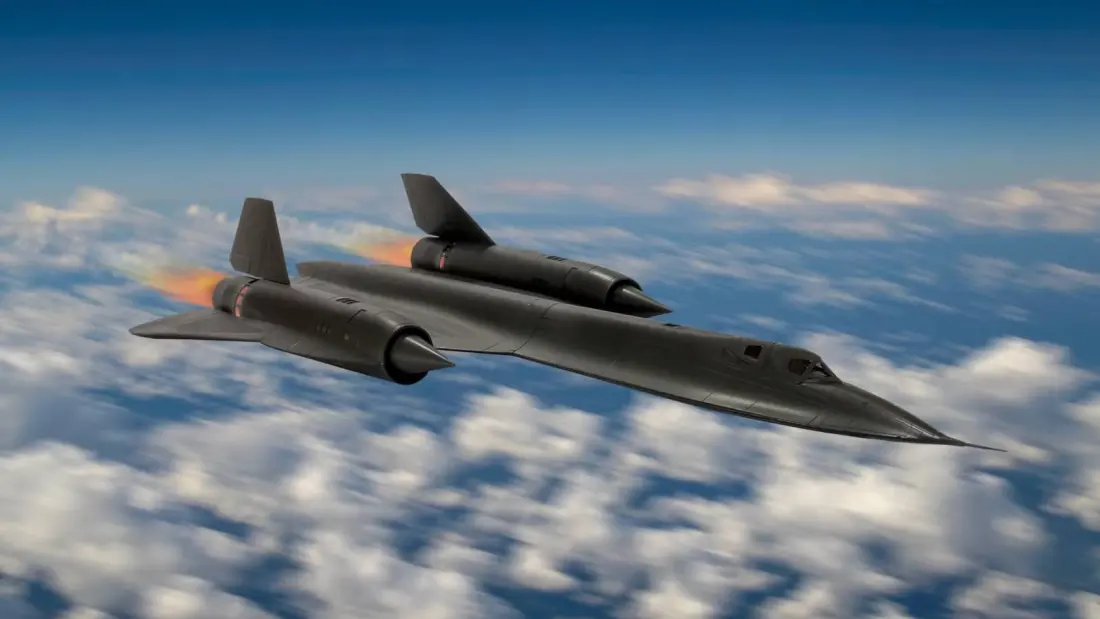
On 28 July 1976, a Lockheed SR-71 Blackbird set an absolute speed record for a crewed air-breathing aircraft: 2,193.2 mph (3,529.6 km/h), roughly Mach 3.3. Almost fifty years later, no crewed jet has gone faster. The same day, a Blackbird also set the world record for sustained altitude in horizontal flight at 85,068 feet (25,929 m) — not a brief zoom climb, but level, controlled cruising at the edge of space.
To put that in perspective, commercial airliners cruise at 35,000 to 43,000 feet, and the Blackbird flew comfortably above 85,000. At its normal operational speed of around Mach 3.2, it could cross the continental United States in about an hour — roughly 0.61 miles every second. Some accounts suggest it occasionally pushed past Mach 3.4 in exceptional circumstances.
The Blackbird grew out of the CIA's secretive A-12 programme, masterminded by Clarence 'Kelly' Johnson at Lockheed's Skunk Works. After the U-2 spy plane proved vulnerable to interception, engineers set out to build a jet that survived not by hiding but by simply being impossible to catch. That meant sustained flight above Mach 3, which in turn demanded a titanium airframe to withstand the heat of air friction, plus specially engineered engine inlets and fuel systems. President Lyndon Johnson announced the aircraft in July 1964, the prototype first flew that December, and operational jets reached the US Air Force in 1966. Only 32 were ever built.
For 24 years, crews flying out of Beale Air Force Base in California ran strategic reconnaissance missions over Europe, the Middle East and Asia, relying on speed and altitude as their only defence. The fleet was retired in January 1990 — not because it failed, but because it was extraordinarily expensive to run, satellites were taking over deep surveillance, and the Cold War was winding down. Congress funded a brief reactivation in 1995 before final retirement in 1997, and NASA kept a few flying as research aircraft until the very last Blackbird flight on 9 October 1999.
For aviation-minded travellers, the story isn't quite over. Blackbirds are preserved at several museums across the United States, including the Smithsonian's National Air and Space Museum facility in Virginia, where you can stand next to the fastest machine ever flown by a human crew. It's a rare chance to see up close how radical Cold War engineering got — and to appreciate a record that has outlived the aircraft itself by half a century.
Story via Simple Flying.