Skip the queues in Venice for a moment. Some of the most compelling places to visit are towns everyone else left decades ago — and they're often eerily intact.
Take Bannack, Montana. By 1863, a year after its founding, more than 3,000 people lived in this Gold Rush boomtown, which briefly served as Montana's first capital. When the gold dried up, so did the population — and the town sheriff, it turned out, had been secretly running a criminal gang the whole time. Protected as a state park shortly after abandonment, Bannack retains around 50 original buildings and is considered one of America's most complete Old West towns. Visitors report hauntings in the former courthouse-hotel and general store.
California's Bodie offers a similar time-capsule effect on a bigger scale. Once home to over 7,000 people and 2,000 buildings, about 200 structures survive in a state of "arrested decay" — dishes still on tables, furniture in the homes — since it became a state historic park in 1962. Prospector Waterman Bodey struck gold here in 1859; residents drained away as the mines did, and a 1932 fire finished the job.
Not every ghost town is American. Belchite in Spain is essentially a battlefield memorial: roughly 3,000 people died there in under three weeks in 1937, during one of the Spanish Civil War's deadliest battles. Franco deliberately left the ruins standing beside a brand-new village he ordered built, so his defeated opponents would live with the reminder. Access is by guided tour only.
In Italy, Craco's hillside ruins — used as film locations for "The Passion of the Christ" and "Quantum of Solace" — were abandoned after a string of disasters: landslides from 1963, a flood, then a 1980 earthquake. The site has ancient roots, with tombs dating to the eighth century B.C.E., and former residents keep its memory alive through a society and religious festivals.
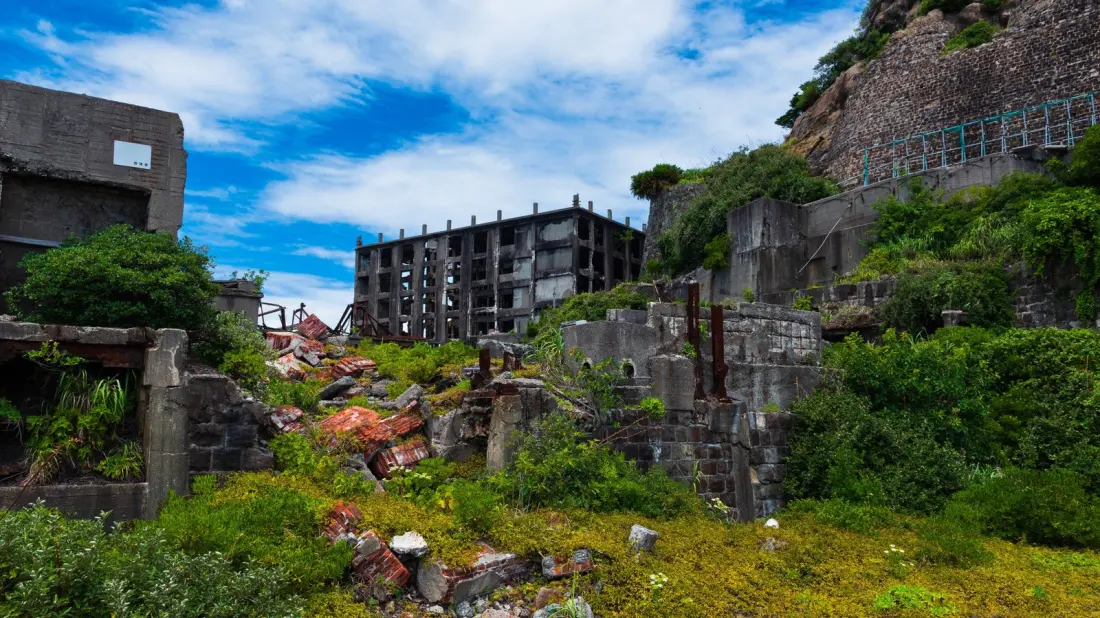
Japan's Hashima Island is arguably the most dramatic. A 15-acre coal island run by Mitsubishi, it once held over 5,000 residents, making it one of the most densely populated places on Earth. When the mine closed in 1974, everyone left. Guided boat tours (about 40 minutes each way) began only in 2009, and visitors view the crumbling concrete blocks from a distance. Its dark history includes the deaths of forced Korean and Chinese wartime labourers, and its silhouette inspired the villain's lair in "Skyfall."
For pure atmosphere, two standouts: Kolmanskop in Namibia, founded in 1908 during a diamond rush so rich it produced nearly 12% of the world's diamonds at the time, now has sand-filled houses you can walk through after a short bus ride from Luderitz. And Houtouwan on China's Shengshan Island is a fishing village completely swallowed by ivy and vines since its 2002 abandonment — best visited in summer when the greenery peaks, though it takes a three-and-a-half-hour ferry from Shanghai.
Closer to home, Alabama's Old Cahawba — the state's first capital, abandoned after repeated flooding — now operates as an archaeological park with a Gothic church, Civil War prison site and cemeteries.
These places suit travellers who want history with atmosphere and no crowds. Just check access rules first: several, including Belchite, Craco and Hashima, require guided tours, and safety barriers can be minimal.