
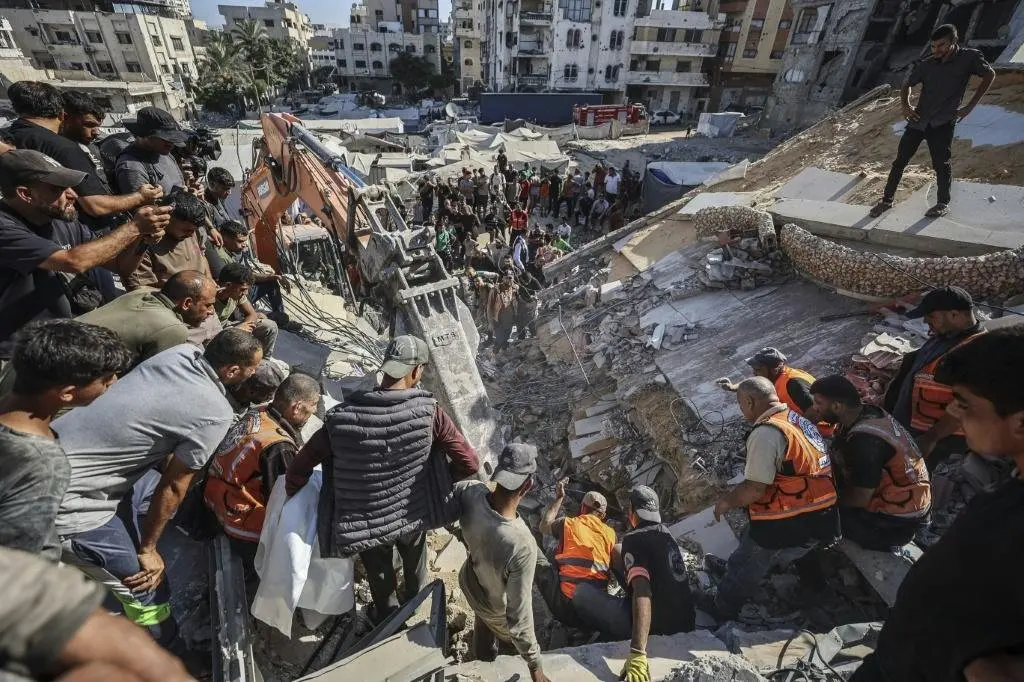
A six-storey apartment block in Gaza City's Tal al-Hawa neighbourhood collapsed overnight onto homes and tents below, killing 21 people — including 12 children and five women, according to Gaza's health and interior ministries. The building, which had four apartments per floor, had been damaged in earlier Israeli strikes and was sheltering more than 100 displaced people at the time.
Gaza's civil defence agency, which operates as a rescue service under the Hamas-run authorities, said teams worked for hours to recover bodies trapped under the rubble and transported 45 injured people to hospital. The building had been hit multiple times in 2024 and again in March 2025, and residents had been warned not to return. Many did anyway — not out of choice, but because with tents and intact homes in desperately short supply, damaged buildings are often the only shelter available.
The scale of the danger is wide. Gaza's civil defence agency has identified roughly 2,000 buildings across the territory it considers at risk of collapse, and the United Nations says the vast majority of buildings in Gaza have been damaged or destroyed since the war began. That war started after the Hamas-led attack of October 7, 2023, which killed more than 1,200 people; Gaza's health ministry says Israel's subsequent campaign has killed more than 73,700, figures the UN considers reliable.
The UN's humanitarian coordinator for the occupied Palestinian territories, Ramiz Alakbarov, said he was devastated by the collapse, calling it a stark reminder that no one should risk their life simply to find safe shelter. The International Committee of the Red Cross supplied materials to assist the search effort, and excavators bearing Egyptian flags helped clear debris.
A US-brokered ceasefire declared in October 2025 has allowed additional aid into Gaza, but strikes have continued and Israel still restricts entry of equipment it says could have military uses — a key factor in the shortage of construction materials that leaves so many families with nowhere safe to live.
This is a breaking news story rather than a travel item, and click.holiday is running it because the situation fundamentally affects the region for any traveller watching the Middle East. Gaza remains off-limits for tourism, with foreign governments advising against all travel. Travellers with connections to the region — family visits, humanitarian work, or trips to neighbouring Israel and Egypt — should follow official guidance closely, as the humanitarian situation and security conditions continue to evolve. Details may develop as rescue and verification work continues; this brief is based on reporting filed Wednesday via AFP.
Story credited to Japan Today (AFP).