
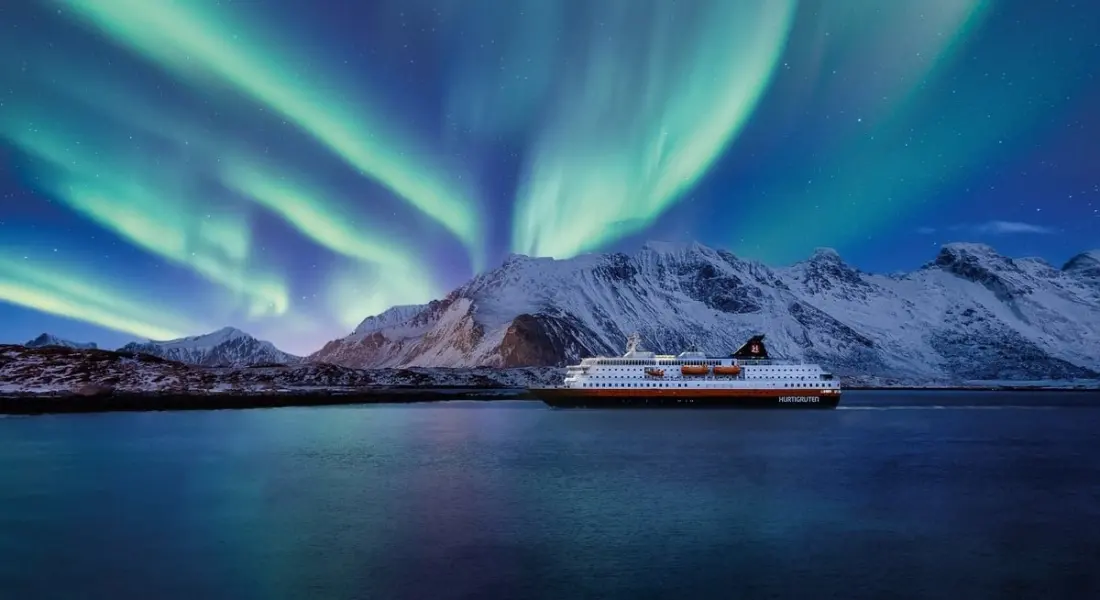
On Hurtigruten's original Norwegian coastal voyage, the menu tells you exactly where your dinner came from — and often, who grew or caught it. The line's Coastal Kitchen programme sources from more than 70 farms, fisheries and producers along the route: shrimp from Lyngen Reker, cod and Arctic char from Sigerfjord Fish and Myremar, vegetables and herbs from Myklevik Farm in Lofoten, and seaweed from Lofoten Seaweed, a small company started by two friends. Producers are named onboard, turning the supply chain into part of the story rather than a footnote.
That naming is more than marketing. Carly Biggart, the line's former Head of Americas, describes local partnerships as the product itself, not a feature of it — and some of them have changed how the ships operate. Working with Myklevik Farm and the port of Stamsund, Hurtigruten installed a reactor that converts the Original Voyage ships' edible food waste into compost within 24 hours. The compost is trucked to the farm, used as fertiliser for the vegetables the ships then buy back. Food scraps become next season's salad: a genuinely circular loop that travellers can ask about and get a specific, verifiable answer.
The partnership model extends well beyond food. In Kjollefjord, a fishing village of roughly 1,000 people, a Sami-owned snowmobile and cultural experience business grew from nothing into a year-round employer, with the reliability of regular ship calls as its commercial backbone. Then there's the Open Village concept, which flips the usual cruise excursion script: communities that had never received tourists before decide what they want to share, guests pay nothing extra for the experiences, and Hurtigruten pays each village directly per visit. The community designs the product; the operator follows.
Hurtigruten pairs all this local embeddedness with global membership in bodies like the Adventure Travel Trade Association, which the company credits with providing benchmarking, accountability and exposure to how responsible tourism is evolving elsewhere. The logic: local relationships shape what the voyage delivers, global ones shape how the company keeps improving.
Why does this matter if you're booking a Norwegian coastal cruise? Because the differences between operators are increasingly found in details like these. If your priorities include knowing where your food comes from, seeing tourism revenue reach small communities rather than port operators alone, or having a sustainability story that holds up to questions, Hurtigruten's named-farm, named-village approach gives you something concrete — and gives travel advisors a genuine differentiator when clients ask why this sailing costs more than a generic fjord cruise. The line's own framing is that long-term, values-aligned partnerships beat short-term contracts; whether or not you buy the philosophy, the traceability on your plate is real and easy to check. A final instalment of the series on the company's long-term vision is expected in October 2026.
Story via Adventure Travel News.