
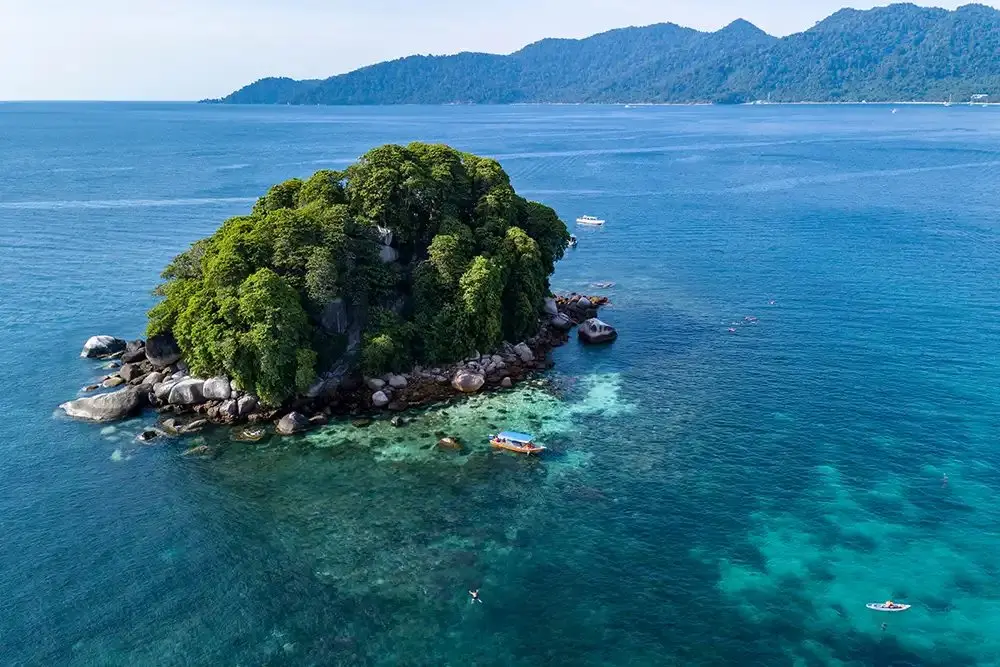
A 65-year-old Indian tourist has died after slipping from a dive boat ladder off Malaysia's Tioman Island, in an accident that highlights how quickly a beginner-friendly dive experience can turn dangerous.
The woman, named as Sabiya Shiek, was taking part in an introductory 'discovery diving' session near Pulau Renggis, a small islet off Tioman's west coast, on Saturday 12 September. She was with six family members, supervised by two instructors and a divemaster. She had no diving licence — typical for a discovery dive, which is designed for first-timers.
According to Rompin district police chief Superintendent Sharif Shai Sharif Mondoi, speaking to local media, the group had been diving at a depth of around 7 metres. After roughly 15 minutes underwater, Shiek signalled she wanted to end her dive and was escorted back to the boat by her instructor, who then returned to the water. Her daughter helped her take off her diving equipment.
It was at this point that things went wrong. While climbing the boat's ladder and holding her daughter's hand, she is believed to have slipped and fallen back into the sea. With her gear already removed, she was not equipped to stay at the surface and did not resurface. The instructor began a search once told of the fall, and Shiek was found unconscious on the sandy seabed near the dive site about 15 minutes later. She was rushed to Kampung Tekek Health Clinic on Tioman but was declared dead on arrival.
Pulau Renggis is a popular spot for exactly this kind of activity — its shallow, sloping reefs make it a favourite with local dive centres for training dives and night dives. That accessibility is part of what makes discovery diving appealing: no certification needed, just a short briefing and a supervised dip in calm, shallow water. But the incident is a stark reminder that the moments at the surface, before and after the dive itself, carry their own risks, especially for older or less confident swimmers.
For travellers considering an intro dive in Malaysia or elsewhere, there are practical takeaways. Ask how long the boat crew will keep eyes on you between the water and the deck, whether a ladder is staffed while people climb aboard, and whether you can keep basic gear — a mask, or a snorkel and fins — on until you're safely on board. It's also fair to ask about the instructor-to-guest ratio; this group had three professionals for seven guests, which is reasonable, yet the accident still happened. If you're not a strong swimmer, say so upfront, and consider staying geared up until you're fully out of the water. Small questions like these cost nothing and could prevent a tragedy.
Discovery diving remains a low-risk activity by most measures, and operators on Tioman and similar islands run thousands of sessions without incident. But this case shows that the highest-risk moment may not be underwater at all — it can be the short, awkward climb from the sea back onto the boat.
Reported by Dive Magazine.