
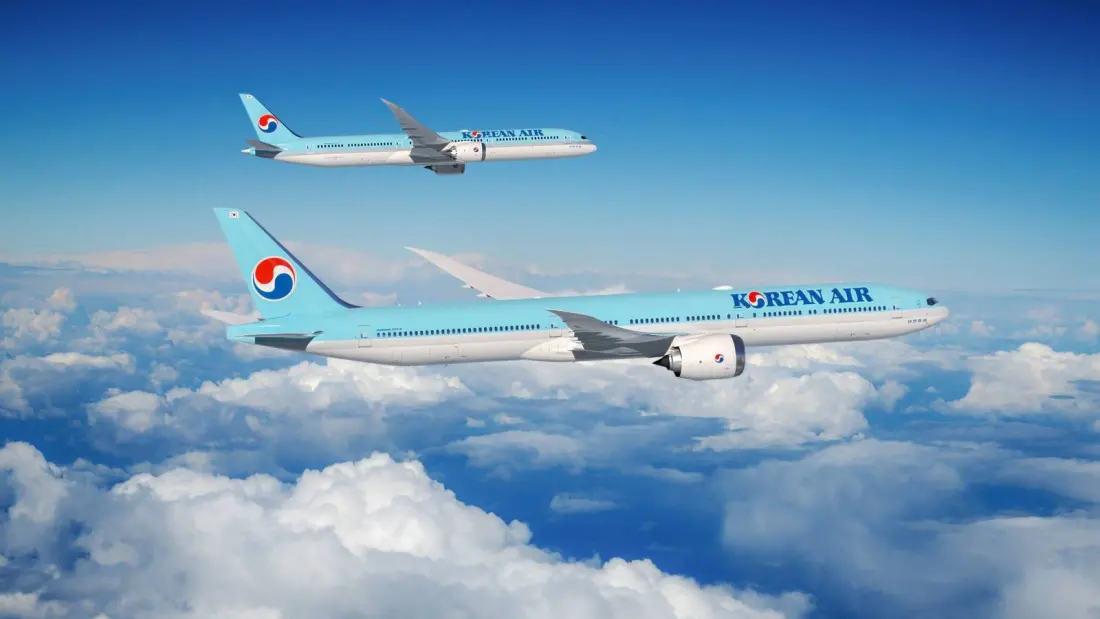
Korean Air has signed the biggest aircraft deal in its history: 103 Boeing planes worth $44.6 billion, confirmed in Seoul on September 16th. For anyone flying to or from Asia in the next decade, this deal reshapes what you'll be sitting in.
The headline grab for travellers is the widebody side. Korean Air has committed to 20 more Boeing 777-9s — bringing its total order to 40 — which will become the airline's long-haul flagship once the type is certified, expected in early 2027. Those are the planes most likely to show up on big routes like Seoul to Los Angeles, where the carrier currently flies its ageing A380s and 747s. Another 25 Boeing 787-10s will cover busy medium-haul Asian routes that don't need anything as large as the 777X.
On the narrowbody side, 50 Boeing 737 MAX 10s will nearly double the airline's single-aisle fleet, slotting in beside its existing 23-strong 737 family. Alongside the 95 passenger jets, Korean Air is also taking 8 Boeing 777-8 freighters, which carry 11 tonnes more payload than the 777F at the same 5,000 nautical mile range — a big deal for a carrier that runs one of the world's largest air cargo operations and is currently absorbing Asiana Airlines' freight network.
There's a merger story behind all of this. Korean Air is building a single, larger carrier out of its integration with Asiana, and the order grows its widebody fleet by 46% while almost doubling the narrowbody fleet. Chairman Walter Cho framed the purchase as the core of a modernisation strategy centred on fuel efficiency and a better passenger experience.
The flip side: some favourite aircraft are on borrowed time. Korean Air plans to retire all its Boeing 747s by 2031 — it still flies four 747-400s and eleven 747-8s — and its five A380s will likely start disappearing in the 2030s. Asiana's six A380s face the same long-term fate. So if you've been meaning to book a flight on a jumbo or a double-decker with Korean Air, the clock is ticking, though both types should remain in service for several more years. Notably, the airline hasn't gone fully Boeing: it also has seven Airbus A350F freighters on order, its first Airbus cargo jets.
Why should a holidaymaker care? New-generation aircraft generally mean quieter cabins, better air quality, faster Wi-Fi and more modern seats — and Korean Air will be one of the earlier Asian operators of the 777-9 when certification lands. The 787-10s should raise standards on intra-Asia routes, while the 737 MAX 10s will bring newer interiors to shorter international sectors. The trade-off is the slow goodbye to the 747 and A380, two of aviation's most distinctive rides. Travellers with a soft spot for either should target Seoul–Los Angeles or other premium heavy routes while they still can. Full details of the order first reported by Simple Flying.