
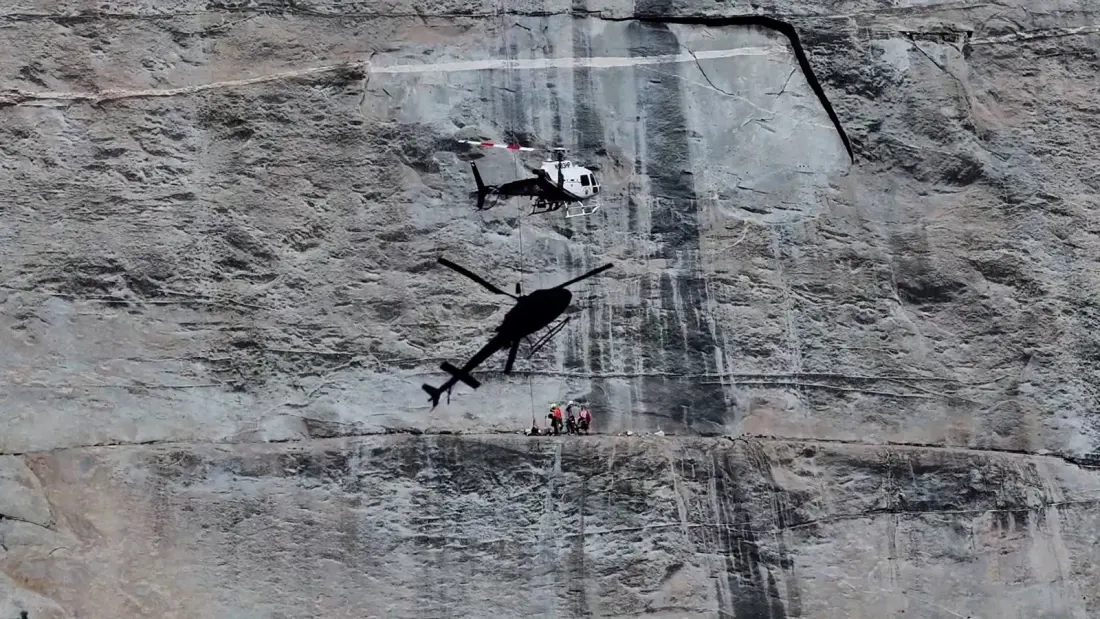
A climber in California's Sierra Nevada fell 200 feet down Power Dome, a 700-foot granite formation near Courtright Reservoir, and ended up bleeding heavily on a ledge barely wider than his shoulders. What happened next was one of the riskier helicopter rescues you'll hear about this year.
The fall happened on September 11 while the climber was ascending the dome. His partners acted fast — they tore off his shirt to use as a bandage and, keeping him tied in, lowered him to a narrow ledge roughly 200 feet off the deck. When rescuers reached him, he had lost a serious amount of blood but was still awake and talking. Flight officer and paramedic Scott Clays, who ran the hoist, later said the man seemed "very tough" and stayed alert the whole way up.
The rescue itself demanded nerve. A Fresno County Sheriff's drone first scouted the scene and sent back images of the climber's position and condition. Then a California Highway Patrol helicopter moved in — to within 15 feet of the vertical granite wall. That's the absolute edge of the crew's safety clearance; any closer, Clays said, risked a catastrophic collision. The technique, known as a big-wall rescue, is the same one CHP crews train for in Yosemite: a technician dangles from a rope as the pilot fights the wind to hold the aircraft steady in 30-to-40-second hovers, then disconnects on the ledge to stabilise the patient. Rescuer and climber were then hoisted up separately and flown to a waiting ambulance. Officials haven't released the climber's name or condition.
Power Dome sits near Courtright Reservoir, a popular climbing and camping area about two hours from Fresno. The formation has around 40 routes spanning trad, sport and toprope across a range of grades, which is part of why the area draws climbers — but authorities didn't say which line the injured man was on.
Why should a traveller care? Because the Sierra's granite playgrounds, however idyllic, carry real risk, and this story is a useful case study in both preparation and response. Climbing partners who could manage bleeding and lower an casualty safely made the difference before any aircraft arrived. It's also a reminder that remote corners of the Sierra — Courtright included — sit well beyond quick road access, so rescue depends on helicopters getting uncomfortably close to terrain. Yosemite alone logs more than 100 climbing accidents a year, and CHP crews use it as their training ground for exactly this kind of work.
If you're heading to Courtright Reservoir or the surrounding domes, go with the usual fundamentals: know your partners' rescue skills, carry a proper first-aid kit rather than improvising with clothing, and assume help will take time to arrive. The granite isn't going anywhere, and neither is the risk.