
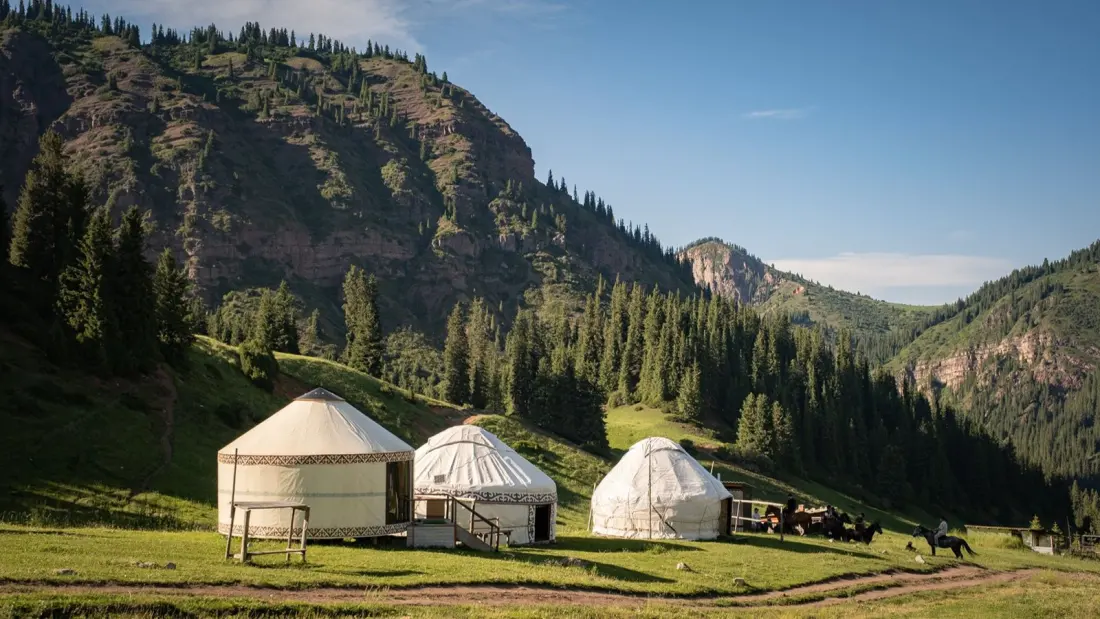
Roughly 90% of Kyrgyzstan is mountains — and about 95% of those peaks don't even have names. That fact, dropped casually by a local guide on a trek through the Tien Shan range, says a lot about the country: huge, wild and almost empty of people. Around 7.4 million residents live in an area slightly smaller than the UK, which is why a 10-day hiking trip through the region can pass with barely another soul in sight beyond the occasional rider on horseback.
One writer recently tested that emptiness for herself on a group trek covering more than 50 miles (80km) at altitudes up to 3,000 metres — arriving underprepared after a winter of illness and surgery. Her route started with a scramble through Kok Moniok Canyon, its burnt-orange rock formations carved into cathedral shapes by wind, where the guide pointed out wild barberries, sea buckthorn and stands of poisonous aconite (wolfsbane) that cows instinctively avoid — a plant so potent it's used in cancer treatment research.
From there the pattern settled into something close to ritual: camp by a stream, wake to birdsong, climb all morning, lunch at the day's high point, descend in the afternoon. A support crew cooked nightly Kyrgyz feasts — cold okroshka soup after hot climbs, slow-cooked dimlama stew with lamb after a misty visit to the Irdyk Lakes in the Terskey Alatau range. The final day followed the Old Jeep Road, an old Silk Road strand between Karakol and China, scented with wild sage, tarragon and lavender, before descending toward Karakol and the turquoise glacial lake Ala-Kul.
The human encounters are the real draw. Semi-nomadic herders move livestock between summer and winter pastures, building temporary camps of yurts and caravans in the valleys. One herder, Talai, crossed a river with his cows, a horse and three Alsatians, then offered the group fermented mare's milk — kymyz, the classic Central Asian drink that divides travellers sharply — and mentioned winters split between Karakol and Bishkek, plus occasional trips to Europe.
Why should this matter to you? Two reasons. First, the practical reassurance: this kind of trek has a leader at the front and a 'sweeper' at the back, so slower hikers aren't left behind or shamed — the writer finished last every single day and still made it to camp for dinner each night, gradually getting fitter as she went. Second, the destination itself: Kyrgyzstan delivers genuinely remote, high-alpine scenery, Silk Road history and a living nomadic culture, all at a fraction of the crowds you'd find in the Alps. Come for the glacial lakes and wildflower meadows; stay for the rhythm of a simpler life — and, if you're brave, the karaoke restaurants of Karakol, where the trip ended over plates of 'lazy tongues' (fried aubergine).