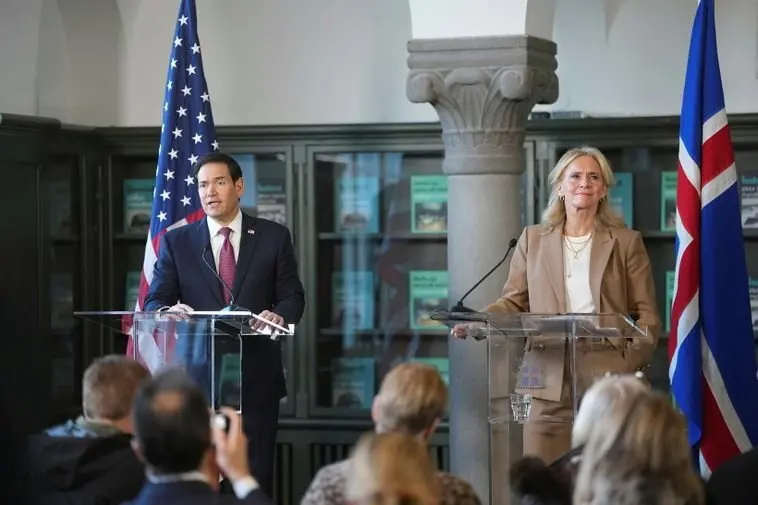
US Secretary of State Marco Rubio landed in Reykjavík this week for his first visit to Iceland, a short trip that touched on everything from Arctic security to the booming number of American tourists heading north.
Rubio arrived on Monday and started his day at the historic Höfði House with Icelandic Foreign Minister Þorgerður Katrín Gunnarsdóttir, before meeting Prime Minister Kristrún Frostadóttir at Safnahúsið on Hverfisgata. The visit drew a heavy security presence, with armed police stationed at Höfði and Hverfisgata closed to traffic for the morning.
The tourism angle came up early. Rubio noted that around 700,000 Americans have visited Iceland and mused aloud whether that figure could hit one million soon. For a country of roughly 400,000 people, American visitor numbers are a serious economic story — and one that keeps growing thanks to direct flights from the US East Coast and Iceland's role as a stopover hub between North America and Europe.
On security, Rubio called Iceland increasingly important to the United States, saying it "sits in the middle" of the North Atlantic at a time of rising threats. He did not rule out an expanded US military presence, pointing out that American forces were stationed in Iceland in force until 2006 and that the two countries remain tied by the 1951 defence agreement. He confirmed the US would continue to defend Iceland and its surrounding waters. Asked about President Trump's recent social media post depicting Iceland, Greenland and Canada as US territory, Rubio brushed the question aside, saying he was not there to discuss social media and that relations were entirely positive — a line Foreign Minister Gunnarsdóttir largely echoed.
Beyond defence, Rubio flagged chances for deeper economic ties: US investment in Icelandic geothermal energy and marine science, and more Icelandic products and companies finding a market in America. He even name-checked NASA's Apollo-era astronaut training in Iceland's lava fields as an example of the countries' long, unusual history together.
Why should travellers care? For one, closer US–Iceland ties tend to mean more flights and competition on the transatlantic route, which keeps fares in check. Iceland remains one of the easiest and safest foreign trips for Americans — no visa needed for short stays, English widely spoken, and a reputation as the world's safest country that Rubio himself cited. And if American arrivals really do climb towards a million a year, expect Iceland's most famous sights to get busier, making shoulder seasons and lesser-visited regions like the Eastfjords or the Westfjords smarter picks than ever.