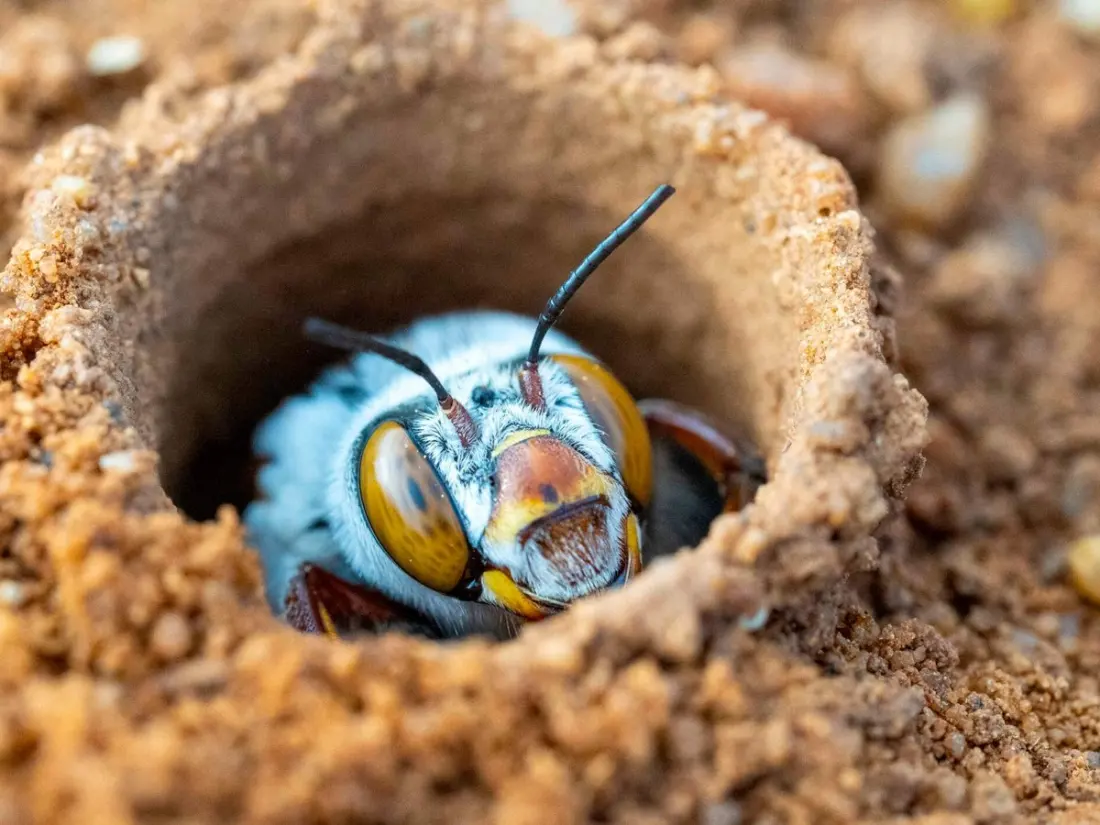
For most of the year, the clay flats of central Western Australia look like nowhere special. Then spring arrives, and the ground quite literally breaks open. Out come thousands of Dawson's burrowing bees, one of Australia's most overlooked native icons, ready to cram an entire lifetime into a few frantic weeks above ground.
The males emerge first and have nothing to do but patrol the nesting grounds, waiting. When females finally appear, they release a chemical signal that triggers an immediate scramble. A single female can be mobbed by ten or more males at once, biting and grappling in a knot that can last ten minutes. Bush Heritage's Hamelin Station Reserve, which hosts thousands of these burrows each year, had a manager describe it as a ball of twenty chunky bees rolling around one female. It's genuinely dangerous: males can die in the scrum, and so, sometimes, can the females.
Once a female mates, her chemical signal changes, the other males instantly lose interest, and she gets on with the actual work. Her burrow runs 15-30cm into the clay, lined with wax and stocked with a nectar-and-pollen mix. She lays one egg per brood cell, seals it with mud, and then dies. The males die almost immediately after mating too. The larvae, meanwhile, sit safely underground, well fed, for most of the year until it's their turn to surface and repeat the whole chaotic cycle.
Why should a traveller care? Because this is one of those rare, very local natural spectacles that most people have never heard of. Every spring, stretches of red-earth Western Australia hum with the largest communal burrowing bee gatherings in the country, and you can witness the frenzy if you time it right. The Hamelin Station Reserve, near Shark Bay, is a working conservation property where the phenomenon is well documented, and the surrounding Gascoyne region offers plenty else to fill a road trip: Shark Bay's World Heritage coastline, stromatolites at Hamelin Pool, and the wildflowers that bloom across the midwest in the same season.
It's also a reminder that Australia's most interesting wildlife isn't all cute and cuddly. Some of it is a lethal rugby scrum with wings. The piece even nods to research showing bumblebees enjoy playing with toy balls, prompting the very fair observation that evolution produces both whimsy and mayhem depending on the species.
If you're driving the Coral Coast between August and October, keep an eye out for pockmarked clay flats with telltale burrow holes, and give the bees room to do their thing. No one involved in that mating ball is having a good time, and a respectful distance is the best way to watch.
Australian Geographic