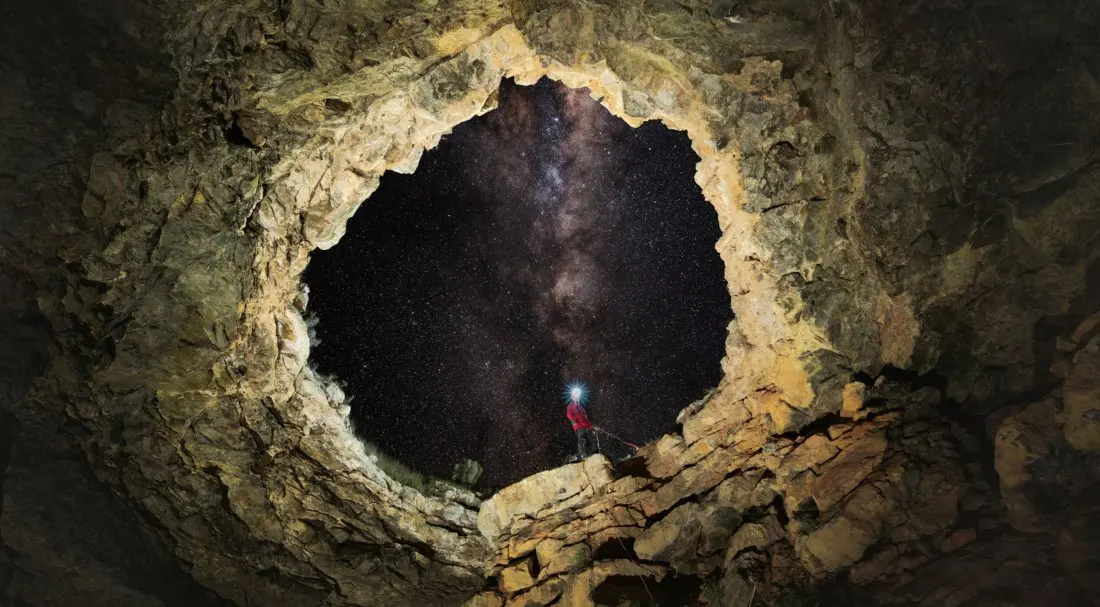
The cover of Wild Magazine Australia's Issue #201 is a stunner: a sinkhole on the Nullarbor Plain, its entrance framing the core of the Milky Way like a giant eye staring back at the galaxy. Photographer Stefan Eberhard captured it in midwinter 2023, on a moonless, clear night when the cave's angle and the galactic core happened to line up perfectly. He titled the image "Earth, Eye, Sky".
The Nullarbor, whose name is Latin for "no trees", is famous for one of the flattest, most treeless stretches of land on Earth, spanning southern Australia between Western Australia and South Australia. What fewer travellers realise is what lies underneath: one of the world's largest arid limestone karst systems, riddled with caves of genuine scientific and visual significance. The entrances open abruptly as gaping sinkholes in the desert floor, dropping into a dark underworld. Eberhard, a cave diver since his youth, first stood at this particular edge 43 years ago, when his dive buddies described a huge submerged tunnel some 80 metres down, barrelling off into the unknown. He has returned repeatedly over the decades to dive, research and photograph the caves.
The 2023 trip had a purpose beyond photography. Eberhard and his wife Bronwen had just learned of a proposal to industrialise the Nullarbor with what would be the world's largest wind- and solar-powered hydrogen and ammonia export hub. They spent nine weeks photographing the caves and surrounding landscape, aiming to raise public awareness and push the case for World Heritage recognition of the region. The cover shot was one of many images from that campaign. Issue #201, the Spring 2026 edition, carries the full story of the threats facing the Nullarbor alongside their imagery.
Why does this matter to travellers? Because the Nullarbor is one of those places people drive across without stopping, on the long haul between Perth and Adelaide, and it rewards anyone who pauses. Its caves, sinkholes and night skies are world-class, and seeing the Milky Way core overhead in the southern winter is something most visitors never plan for. And the region's future is genuinely in question: large-scale industrial development could change it permanently, so if this corner of Australia is on your list, the time to see it is now.
The full feature, including the campaign for World Heritage listing, runs in Wild #201, with more of Stefan and Bronwen's photography in the magazine than appears online.