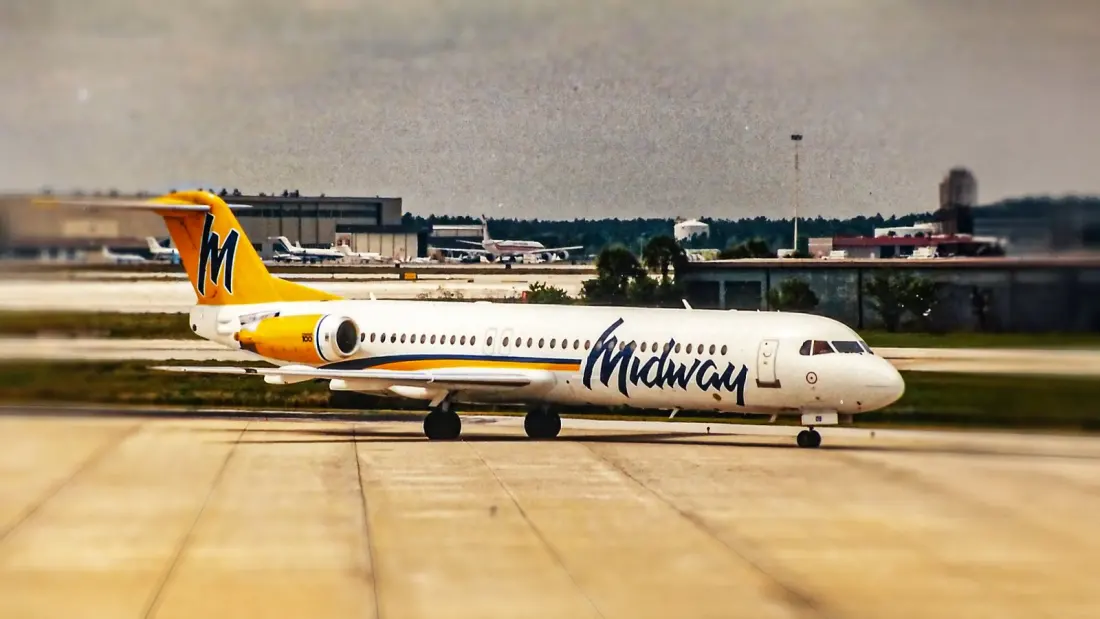
Only one US airline has ever shared a name with its hub, then dropped that hub and kept the name flying anyway. Midway Airlines started life in 1976 with an unusual business plan: revive Chicago Midway International Airport itself.
Midway airport, 11 miles from downtown Chicago, had been the world's busiest before the major carriers migrated to O'Hare through the 1960s. By the mid-1970s its terminals sat mostly empty. Founders Irving Tague, Kenneth Carlson and William Owens saw what Southwest had done at Dallas Love Field and figured the same trick could work in Chicago. With $5.7 million from 16 private investors, they launched flights on November 1, 1979, with three DC-9s to Cleveland, Detroit and Kansas City. It's widely considered the first post-deregulation startup in the US, and within a few years it had brought millions of passengers back through Midway.
Then came three business models in twelve years. Discount carrier, then an all-business-class experiment, then a conventional hub-and-spoke operation. A $900 million aircraft order and a second hub in Philadelphia in 1989 proved fatal — recession, fuel costs and competition from Eastern drained the cash. Midway filed for Chapter 11 in 1991; a rescue sale to Northwest collapsed at the last minute, and the airline shut down on November 13, 1991, having grown from three aircraft to 44 without a single fatal crash. Northwest later hired most of its 4,300 staff.
The twist: the brand outlived the company. A group of investors including original co-founder Carlson bought the name out of liquidation for just $20,000. Jet Express, a commuter operator with certificates but no recognisable identity, snapped it up in 1993 and relaunched as Midway Airlines, flying two Fokker 100s from Chicago Midway to New York LaGuardia.
It lasted 18 months in Chicago. Southwest Airlines, which had entered Midway airport in 1985 and absorbed much of the original carrier's traffic, simply out-competed the newcomer with lower costs and dozens of daily departures. In 1995, Midway relocated to Raleigh-Durham, moving into Terminal C just vacated by American Airlines — a sublease tied to $113 million in terminal bonds. From North Carolina, roughly 640 miles from the airport painted on its fleet, the airline built a genuinely successful East Coast network linking the Northeast to Florida, ran 13 profitable quarters under CEO Robert Ferguson, employed 2,250 people and raised about $38 million in a 1997 IPO.
Southwest found it again. Entering Raleigh-Durham in 1999, the low-fare giant eroded exactly the connecting traffic Midway depended on. After September 11, 2001, the airline suspended flights, made a brief comeback, folded again in July 2002, then resurfaced in 2003 as a US Airways Express operator before a final Chapter 7 shutdown on October 30, 2003. The $20,000 name finally died in a state where it had never meant anything.
For travellers, it's a reminder of how much of the modern US airport map — Southwest's dominance at Chicago Midway, American's abandoned RDU hub — was shaped by this scrappy, doomed carrier.