One of palaeontology's more patient stories has finally paid off. A giant fossil abandoned on a remote Arctic island more than 75 years ago has turned out to be a brand-new species — and the biggest of its kind ever found.
The animal has been named Arctobatrachus urdensis, a predatory amphibian from the Triassic period (roughly 251 to 201 million years ago) that grew to about 2.7 metres long. It belongs to the plagiosaurids, a group of broad, flatt-bodied aquatic creatures, and at that size it dwarfs every other known member of the family.
The tale begins in 1948, when a British expedition landed on Bjørnøya — Bear Island — in Norway's Svalbard archipelago, in the Barents Sea between mainland Norway and Spitsbergen. The specimen was simply too big to carry away, so the team photographed it, took a few bones and left the rest to the elements. Norwegian scientists relocated it in 1984 and excavated it properly. Decades of Arctic weather had chewed into the exposed remains, which is where those 1948 photographs became invaluable: they preserved anatomical details that had since been destroyed, allowing researchers to fill in the gaps.
The fossil eventually reached the State Museum of Natural History in Stuttgart, where Rainer Schoch and colleagues studied it and realised its features matched nothing previously known. Their findings were published in the peer-reviewed journal Papers in Palaeontology. The genus name pairs the Greek words for bear and amphibian — a nod to the island — while urdensis honours Urd, the mountain peak where the fossil sat.
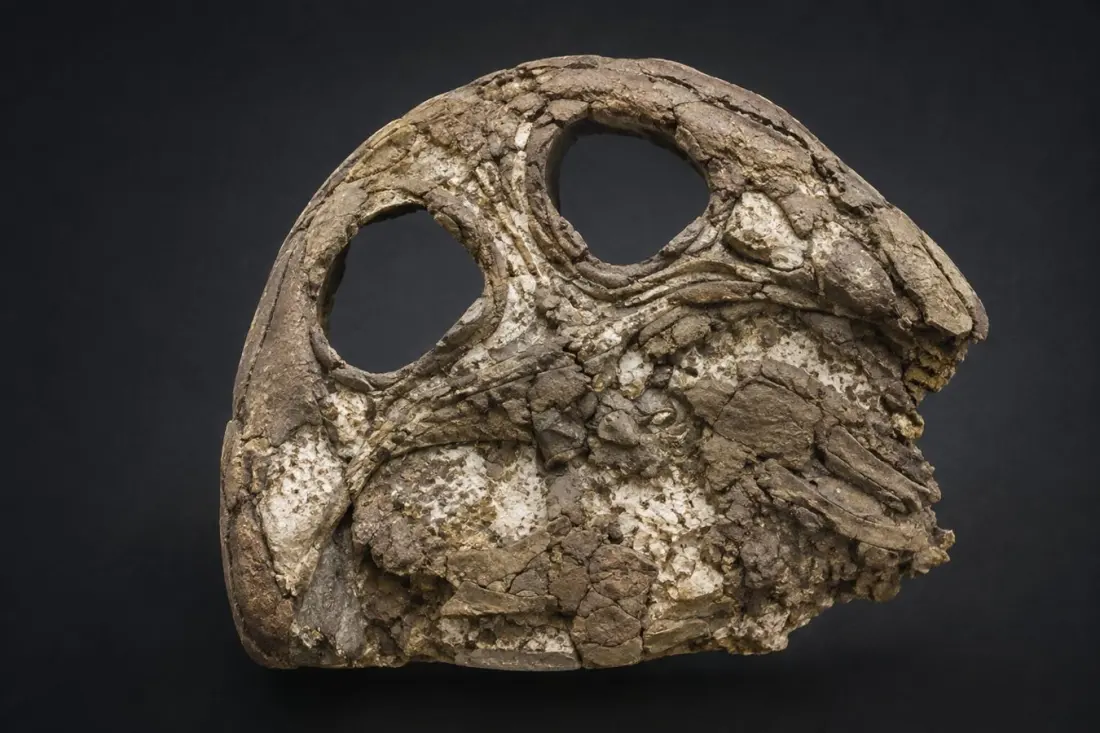
The creature's skull is the standout feature: about 70 centimetres wide but only 21 centimetres long, almost semicircular in outline, with a big mouth and teeth suggesting it actively hunted prey and sat high in its aquatic food chain. Its anatomy also marks it as one of the earliest known plagiosaurids, hinting that the group's ancestors were more active swimmers before evolving into the flatter, bottom-dwelling form of later species.
There's a travel angle hiding in all of this too. Bjørnøya sits at high northern latitude, yet during the Triassic the region was far warmer and lay somewhere else entirely on the globe. Schoch notes the species thrived in the hot period after the end-Permian mass extinction, around 252 million years ago, which wiped out most life on Earth. The idea that a tropical-scale giant once cruised Arctic waters is exactly the kind of story that makes Svalbard's geology so compelling for curious visitors.
For travellers, Svalbard already delivers fossil-rich rock formations, expedition cruises and stark polar scenery — and Bear Island, though rarely visited and notoriously exposed, sits on the fringes of that world. Even if you never set foot there, the story adds a layer of deep time to any Norway trip: the Arctic archipelagos were once warm, teeming waterways.
This one is for the science-curious traveller — the sort who'd happily detour to a natural history museum or book a Svalbard voyage after reading about a fossil saved by 1940s photography.
Via Colombia One.