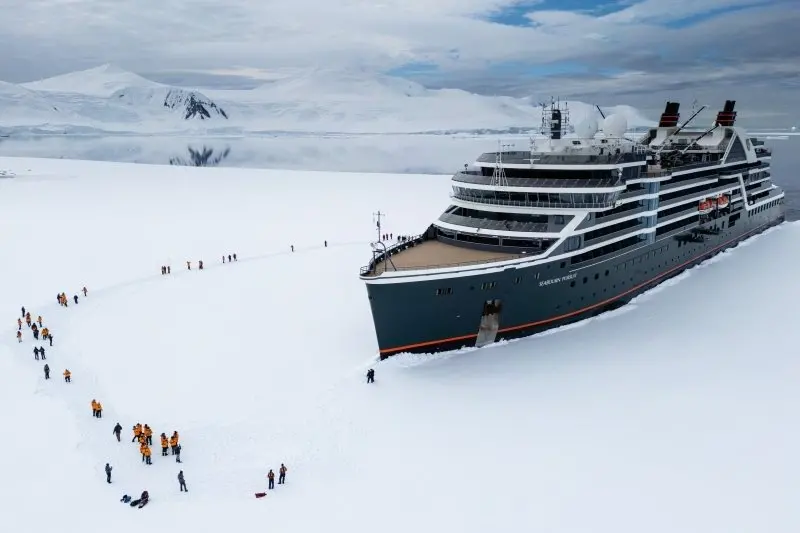
Seabourn has revealed the experts who will sail with guests to Antarctica in the 2026–27 season, and it reads like the faculty of a small polar university. Between November 2026 and March 2027, the line's two purpose-built expedition ships, Seabourn Venture and Seabourn Pursuit, will run 19 departures roundtrip from Ushuaia, Argentina, with itineraries of 10 to 12 days. Longer 20-day versions add South Georgia and the Falkland Islands for travellers who want the full South Atlantic wildlife circuit.
Every sailing comes with a 21-person expedition team on board — marine biologists, geologists, conservationists, ornithologists and polar historians whose job is to turn a cruise into a crash course in the far south. Guests hear lectures through the Seabourn Conversations programme, then meet the same experts out in the field: spotting seabirds from Zodiacs, getting a geologist's take on the glaciers, or hearing tales of the early polar explorers. Named specialists this season include marine mammal scientist Dr. Sean Todd, whale researcher Molly Gaughan, ornithologist JJ Apestegui, archaeologist and Viking scholar Dr. Elizabeth Pierce, and astronomer Vishwa Rana, who doubles as an Indigenous cultures specialist. Operations are led by five expedition leaders, including Luciano Bernacchi and Fridrik Fridriksson.
The logistics are handled for you, which matters more than usual at the bottom of the world. Fares include a pre-cruise hotel night in Buenos Aires plus charter flights down to Ushuaia and back — so the usual scramble of connecting through Argentina's far south is bundled into the trip. From there it's straight across the Drake Passage with experts on hand almost immediately.
Why does the staffing news matter to a traveller? On expedition cruises, the team genuinely makes the trip. Two ships can visit the same penguin colonies on the same day, but the depth of the on-board talks, the number of Zodiac landings and how much you actually learn along the way depend on who is aboard. Seabourn's pitch is clearly that its experts are a differentiator, and the lineup suggests serious scientific credentials rather than generic naturalist fillers.
The season structure also gives flexibility on time and budget. If Antarctica itself is the goal, a 10-day sailing keeps things focused; if South Georgia's king penguin beaches and the Falklands are on the list, only the 20-day departures will get you there, so book one of those specifically. Antarctica sells out early for expedition cruising in general, and with a fixed window of November to March — the austral summer, when wildlife is most active and channels are open — planning well ahead is the norm.
This one's for travellers who want comfort plus substance: Seabourn's ships are luxury vessels, but the programme is built around education and landings rather than ballrooms and buffets. If you've been waiting for an Antarctica trip where you can ask a whale researcher about feeding behaviour over dinner, the 2026–27 schedule is the moment to look at dates.
Story via Cruise Industry News.