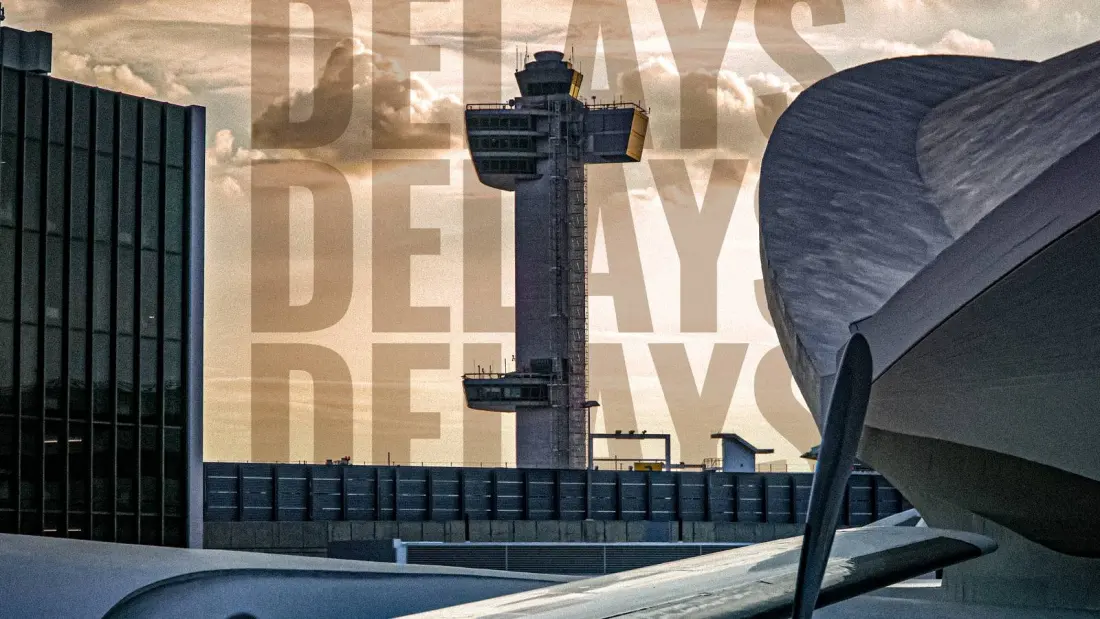
A single piece of damaged telecoms infrastructure brought air travel across the US Northeast to a near-standstill on Monday, with the FAA declaring "ATC Zero" — its term for when a control facility simply cannot handle traffic — and halting flights into New York JFK, LaGuardia, Newark, Philadelphia and Westchester County, with Boston also snarled by diverted traffic.
The trouble started around 9:31 AM, when the FAA reported frequency problems at Philadelphia Terminal Radar Approach Control (TRACON). That facility matters far beyond Philadelphia: since 2024, its Area C sector has handled all arrivals and departures at Newark, after the FAA shifted Newark's airspace away from chronically understaffed New York TRACON (N90). So when Philadelphia's systems went down, Newark went down with it. By early afternoon, New York TRACON was reportedly ATC Zero too, and ground stops had spread to JFK, LaGuardia and Westchester.
The scale of disruption was heavy even by New York standards. Newark alone saw more than 200 delays and 380 cancellations, with average delays exceeding four hours; Philadelphia recorded roughly 370 delays and 130 cancellations, also averaging 4+ hours. More than 600 flights were held up across those two airports, over 20% of their schedules. Boston absorbed diversions but was poorly placed to help — one of its main runways is in the middle of a 75-day closure for safety works, so Logan faced severe delays from sheer volume rather than its own equipment failure.
FAA Administrator Bryan Bedford traced the root cause to a construction crew in New Jersey accidentally cutting a backup fiber line. That left the system without redundancy when another circuit failed, and controllers reportedly lost both radio and radar capability. The sting: the FAA completed a new fiber network between New York and Philadelphia just last year, explicitly designed with two separate paths so one failure wouldn't take everything down. It follows repeated Newark outages in 2025, after which the agency added high-bandwidth connections and worked toward a separate radar-processing hub at Philadelphia.
Recovery began by early afternoon as systems were rebooted, but trackers warned restarts after an ATC failure are slow — controllers first handle aircraft already stuck mid-disruption, and evening schedules typically stay messy, with delays potentially spilling into the next day. Because New York is such a hub, the knock-on effects ripple across domestic and transatlantic networks: United at Newark and American at Philadelphia are most exposed, but dozens of international carriers were caught up too.
For travellers, the practical lesson is that Northeast US itineraries are unusually vulnerable to single-point infrastructure failures — a problem in Philadelphia can shut down New York. If you're flying through EWR, JFK, LGA, PHL or BOS during any ATC disruption, check your airline's app for waivers (airlines typically rebook fee-free during FAA ground stops), expect cascading delays rather than instant recovery, and build slack into any same-day connections. The episode also lands awkwardly mid-way through a $12.5 billion FAA modernization drive, which so far has replaced over 64% of the agency's aging copper telecoms — proof that new hardware only helps if backup paths are truly independent.