
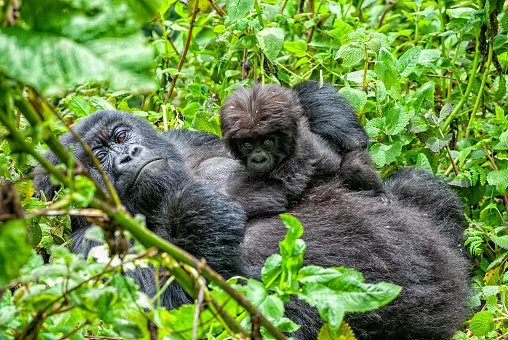
A gorilla rescued as a baby from wildlife traffickers has pulled off one of conservation's trickiest feats: surviving in human care, going back to the wild, and raising a wild-born infant of her own.
Lulingu was just 18 months old when she was rescued in 2016 after being snatched from the forest and sold through the illegal wildlife trade. She grew up at the GRACE Gorilla sanctuary in the Democratic Republic of the Congo — the only facility in the world dedicated to eastern lowland (Grauer's) gorillas — where a female named Pinga acted as her surrogate mother, alongside three other rescued orphans: Mapendo, Ndjingala and Isangi.
In late 2024, all four females were relocated to Virunga National Park and released on Mt Tshiaberimu, a remote mountain area holding a tiny, isolated gorilla population. They were the first eastern lowland gorillas from GRACE ever returned to the wild, and a monitoring team has tracked their feeding, health and behaviour ever since.
The payoff came on 21 May 2026, when Lulingu gave birth to her first infant — the first of the four rewilded females to do so. Conservationists held off announcing the birth for months to let mother and baby bond undisturbed. The father is believed to be Mwasa, a wild silverback on the mountain, which confirms Lulingu has been fully accepted into a wild family group. Monitors report her nursing, cradling and playing with the baby, and she's now described as central to the troop. "Lulingu is doing a great job taking care of the baby," said Benoit Ishaba, head of gorilla monitoring on Mt Tshiaberimu.
The stakes here are real. Mt Tshiaberimu had only eight gorillas before the females arrived, and modelling showed a high chance the population would vanish within 50 years without new breeding females. Their arrival lifted the count to 12, and Lulingu's infant is the first evidence the plan is working genetically as well as socially. Eastern lowland gorillas are critically endangered, so every healthy birth matters for the species' survival.
The story is also a quiet rebuke to the wildlife trade: an animal bought and sold as an orphan has now contributed a new generation to the wild. The other three females are being watched closely too, and conservationists hope more births will follow. For travellers drawn to the DRC's gorilla country, it's a reminder that the gorillas they might one day trek to see are part of a fragile, hard-won recovery — one supported by organisations like Re:wild and decades of patient care.