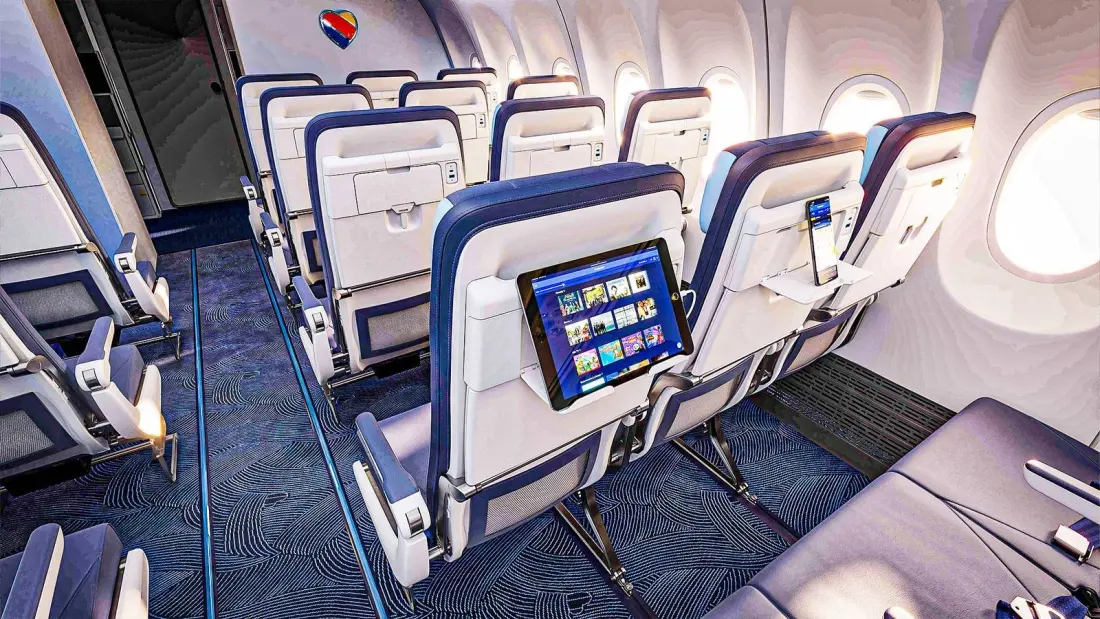
Southwest Airlines has spent the past couple of years shedding its bare-bones image: extra legroom seats across the fleet, new fare types, checked bag fees on cheap tickets, and lounges on the way. The one thing missing from its Boeing 737s is the most profitable cabin of all — a proper domestic first class. And according to a recent analysis, the reason it's tricky to build goes right back to the galleys.
The core problem: Southwest's 737s don't have onboard ovens or full-size forward galleys. The airline has always squeezed in extra seats instead, which kept its per-seat costs low, but first class passengers expect hot meals and real service. Retrofitting ovens is straightforward; ripping out floor space for full-size galleys is not. Every row gained for galley space means rows of revenue seats lost, and Southwest would likely end up with seat counts closer to American, Delta and United — which typically fit 16-20 first class seats into the same aircraft that Southwest packs entirely with economy.
CEO Bob Jordan has acknowledged the airline is looking at a genuine domestic first class and hasn't ruled out lie-flat seats, though nothing is confirmed. Lie-flats are a stretch: they're heavy, they demand even bigger galleys, and in the US they really only pay off on transcontinental routes from New York and Boston to Los Angeles and San Francisco — corporate-heavy markets Southwest has deliberately avoided. With planned expansion heading somewhere more unorthodox, including rumoured nonstops to Reykjavik, the network simply doesn't call for beds.
The likelier outcome is something modelled on the European short-haul playbook: an economy-style seat with a blocked middle and better service, similar to Frontier's Upfront Plus. It minimises capacity loss — a real consideration if Southwest also has to sacrifice seats for bigger galleys — but it risks underwhelming frequent flyers who already question the value of paying legacy-style prices for an airline with no seatback screens.
Why should travellers care? Because Southwest's premium push is happening fast and it changes what your ticket buys. Lounges are already planned or leased in Honolulu, Nashville, Denver, Dallas Love Field and a 40,000-square-foot space in Austin. A new Chase co-branded credit card with an annual fee reportedly between $395 and $650 — well above the current $229 Rapid Rewards Priority Card — is rumoured to bundle lounge access. If you fly Southwest regularly, the next year or two will decide whether the airline becomes a genuine one-stop premium option or just charges legacy prices with a budget experience. Watch this space.
Simple Flying