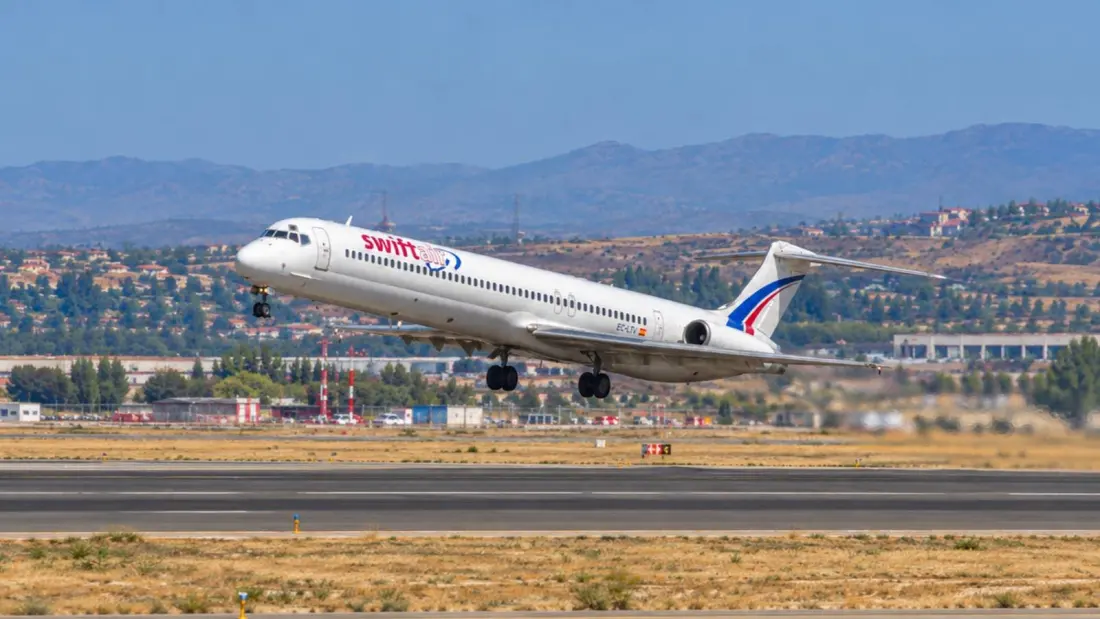
More than twelve years after Air Algérie Flight AH5017 went down in Mali with no survivors, a French court has finally held someone accountable. The Paris Criminal Court found Spanish operator Swiftair guilty of corporate manslaughter over the July 24, 2014 accident, which killed all 110 passengers and six crew aboard the McDonnell Douglas MD-83 it was flying on Air Algérie's behalf. The carrier received the maximum fine of €225,000 (about $256,000) after a three-week trial earlier this year, and has ten days to decide whether to appeal.
The flight had left Ouagadougou in Burkina Faso bound for Algiers, but disappeared from radar less than an hour into the journey. Wreckage turned up the next day across the border in northern Mali, roughly 80 km south-east of Gossi. Investigators pieced together a grim sequence: while cruising at 31,000 feet and steering around storms, the aircraft's engine pressure sensors became blocked by ice crystals. The engine anti-ice system, which would have heated those sensors, had not been switched on. Faulty readings trickled into the autothrottle, which commanded too little thrust, while the autopilot raised the nose to hold altitude as speed drained away. The MD-83 stalled. Stall warnings fired, but investigators found no clear crew input before the autopilot dropped off around 22 seconds later. The aircraft hit the ground at extreme pitch and bank angles.
What makes the verdict notable is what the court focused on: not the ice itself, but Swiftair's oversight. The judges found the captain had not received an adequate proficiency check, and the crew had not flown the required refresher flights after a period away from the aircraft. Prosecutors had also alleged gaps in pilot training for icing and abnormal engine indications, though the court didn't accept every argument. Swiftair continues to insist its pilots were properly trained and blames the accident partly on shortcomings in regulations and operating manuals.
Perhaps the most haunting detail from the investigation: another Swiftair MD-83 had hit nearly the same problem weeks earlier. On June 8, 2014, that crew spotted the dropping speed, activated engine anti-icing, and descended in time — a safe outcome that shared its findings with EASA and, through it, the FAA, feeding corrective measures for crews facing the same scenario.
For the victims' families, the ruling closes a long chapter. Their lawyer, Sebastien Busy, said relatives who fought for over a decade now expect Swiftair to accept the decision. It isn't the operator's only recent tragedy either — a Swiftair-operated Boeing 737 freighter flying for a DHL subsidiary crashed on approach to Vilnius in 2024, with pilot error again flagged.
Why does this matter to travellers? Wet-lease deals like this one are common across Africa and Europe, and most passengers never know which airline actually operates their flight. This verdict is a reminder that the operating carrier's training and safety culture matter, and that criminal accountability — however long it takes — is now a live possibility when corners are cut. With an appeal possible, the legal story may not be over yet.
Reported by Simple Flying.