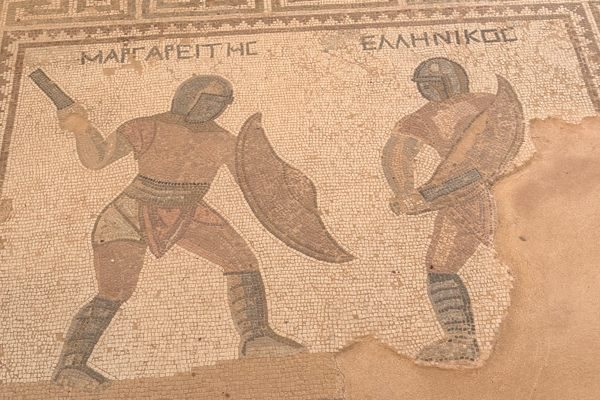
Cyprus's ancient sites are heavy with mosaics — gods, hunts, geometric borders — but gladiators mid-fight are close to unique. That rarity is what earned one modest Roman villa at Kourion its name: the House of the Gladiators. Dating to the 3rd century AD, the floor here depicts combat scenes with the fighters identified by name in Greek inscriptions, something the island's Department of Antiquities considers an exceptional subject in Cypriot mosaic art.
The floor is divided into panels, and the detail is what makes it special. In one, two gladiators square off under their inscribed names: Margarites and Hellenikos, caught at the moment of engagement. In a second panel, an armoured fighter called Lytras advances on an opponent now reduced to a helmeted head and a single foot, while a figure in ordinary clothes — a referee named Darios — holds out a rod as if to step in. It's one of the few spots anywhere in the Roman world where you can attach names, poses and expressions to men who fought in Cypriot arenas, venues that otherwise left hardly a trace.
Practically speaking, the House of the Gladiators sits within the wider Kourion archaeological site, near the Agora and on the route toward the House of Achilles, so it slots naturally into the same visit. The site itself is one of southern Cyprus's headline ancient attractions, perched above the coast with a theatre and sprawling villa ruins to explore alongside the mosaic floors.
Two tips from those who've walked it: keep your eyes peeled for Darios in the second panel, since he's easy to overlook next to the armed combatants. And time your visit for early morning or late afternoon — Kourion is almost entirely without shade and the Cypriot sun makes midday genuinely punishing, especially from late spring through early autumn.
For travellers, this is the kind of detail that rewards a slow visit. You could tick off Kourion's theatre and views in an hour, but the named gladiators give the ruins human faces — literal combatants whose names survived in stone while their arena didn't. History fans, families with school-age kids, and anyone who enjoys a specific story over generic rubble will get the most from it. Pair the site with nearby Limassol for food and accommodation, or Curium Beach below the cliff for a swim afterwards.