
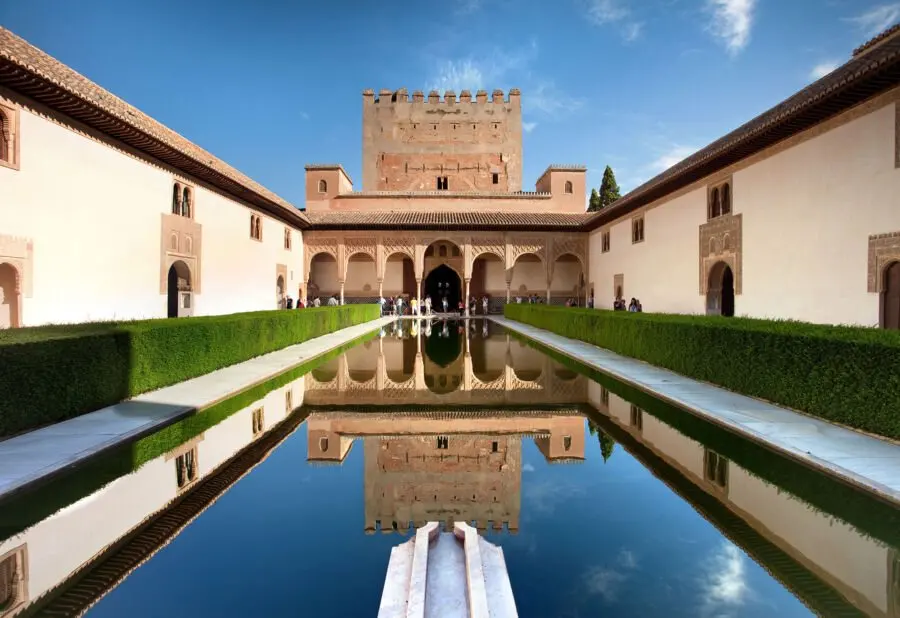
Perched on a hill above Granada, the Alhambra is the last and greatest surviving palace of Moorish Spain — and arguably the most beautiful building in Europe from the medieval Islamic world. For nearly eight centuries (711–1492), much of Spain was under Muslim rule, and while the rest of Europe muddled through the Middle Ages, Al-Andalus flourished in art, science and architecture. The Alhambra is what that golden age left behind.
The heart of the complex is the Palacios Nazaríes, the sultans' residential and ceremonial palace. You enter through the Court of the Myrtles into rooms layered with carved stucco, muqarnas "stalactite" vaults, filigreed windows and fountains. Water is the star here — pooled, cascading and drip-dropping through the halls — a precious commodity treated as the ultimate symbol of life. The Courtyard of the Lions, with its fountain ringed by 12 marble lions, channels water along four paths toward the sultan's private quarters, while walls carry carved Arabic poetry and Quranic verses. Because Islamic artists avoided depicting living beings, they turned to calligraphy and geometric pattern instead; the phrase "only Allah is victorious" reportedly appears 9,000 times across the palace. If the interlocking designs look familiar, that's because M. C. Escher drew direct inspiration from a visit here.
Don't skip the Generalife, the adjacent summer estate with clipped hedges, reflecting pools and playful fountains. Its layout was shaped by the Quran's image of paradise as a garden with flowing rivers — literally a preview of heaven, as far as the sultans were concerned.
The palace's largest space, the Grand Hall of the Ambassadors, doubles as a stage for one of history's great plot twists. Its cedar ceiling is assembled from 8,017 inlaid wooden pieces, evoking the infinite universe. In this very room in 1492, the last Moorish king surrendered to Ferdinand and Isabella — and, in the same year, the Catholic monarchs agreed to fund Christopher Columbus's voyage west. Two world-changing events, one throne room.
For travellers, the Alhambra is the reason to put Granada on a Spain itinerary, and it rewards planning. Tickets sell out days or weeks ahead in high season, so book online early and pick a timed slot for the Nazaríes palaces, which you cannot enter late. Give yourself at least half a day: the site is big, hilly and best enjoyed slowly, ideally in the softer light of early morning or late afternoon. Pair it with a wander through the Albaicín, the old Moorish quarter across the valley, for the classic postcard view of the palace backed by the Sierra Nevada.