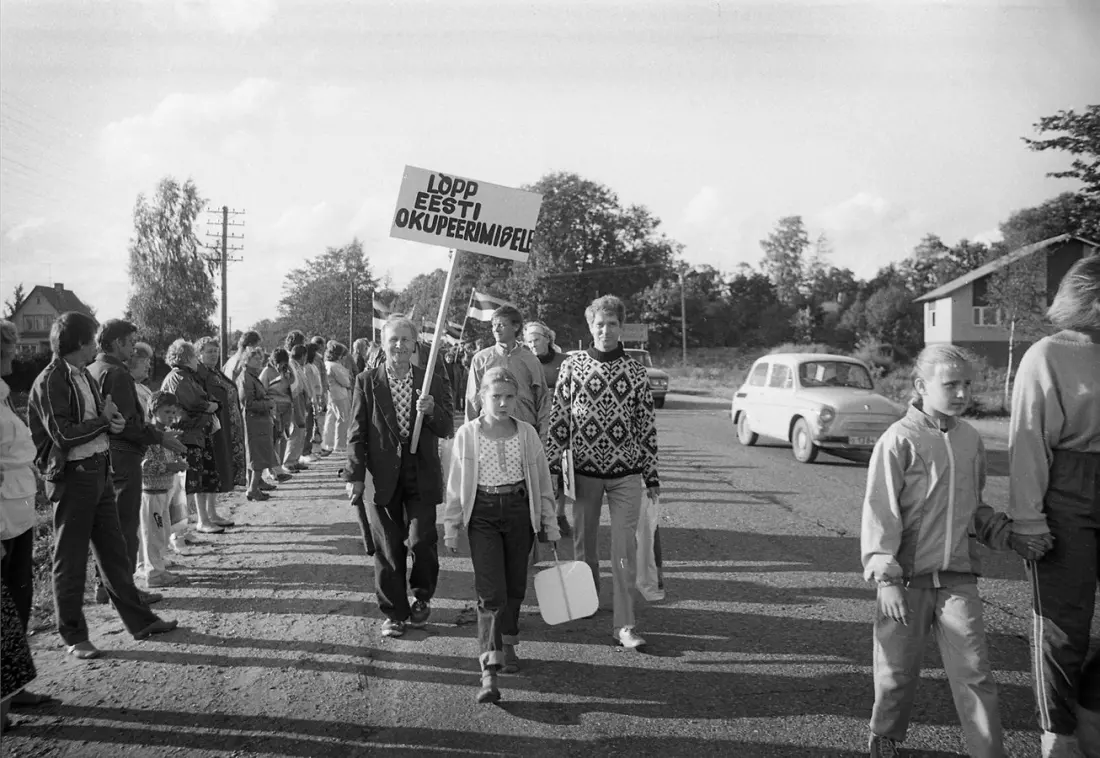
On 23 August 1989, roughly two million people stood shoulder to shoulder along roads from Tallinn to Vilnius, holding hands for fifteen minutes. The human chain stretched 675 kilometres — about 420 miles — through Riga, making it one of the longest unbroken human chains ever assembled, and it happened without a single incident of violence.
The occasion was deliberate: the 50th anniversary of the Molotov-Ribbentrop Pact, signed on 23 August 1939 between Soviet foreign minister Vyacheslav Molotov and his German counterpart Joachim von Ribentrop. The pact's secret protocols carved up Finland, Estonia, Latvia, Lithuania, Poland and Romania into spheres of influence. Germany invaded Poland days later, sparking the Second World War, and the Soviet Union occupied Estonia and Latvia on 16 June 1940.
The Baltic Way was the joint project of the three countries' independence movements — Estonia's Popular Front, Latvia's Tautas Fronte and Lithuania's Sąjūdis. Their aim was to reframe the issue: not a political squabble, but a moral question, and to show the world that ordinary people across the Baltics wanted their independence back. The chain ran from the foot of Toompea in Tallinn, through Riga and across the River Daugava, ending at Gediminas Tower in Vilnius — meaning today's traveller can walk the start and end points in two of the region's most pleasant old towns.
It worked. Within two years, all three Baltic states had restored their independence as the Soviet Union collapsed.
Why does this matter to visitors? Because the Baltic capitals make one of Europe's most underrated road or bus trips, and the Baltic Way is the story that ties them together. Tallinn's medieval old town, Riga's Art Nouveau streets and Vilnius' baroque centre are all within a few hours of each other, and travelling the route — especially around late August — gives you a real sense of what that chain of hands meant. Museums such as Vabamu in Tallinn and the Occupation museums in Riga and Vilnius fill in the context, and anniversaries of the event are still marked with ceremonies and exhibitions along the route.
If you're planning a Baltic itinerary, string the three capitals together over a week or so, add a detour to Estonia's Lahemaa coast or Lithuania's Hill of Crosses near Šiauliai, and you'll have followed the line of one of history's most remarkable peaceful protests. Source: Estonian World.