The Atlantic crossing has quietly become reality TV's favourite laboratory. The Swedish series Över Atlanten is now in its 12th season, with remakes across Denmark, Norway, the Netherlands, Belgium and Poland — and a new Spanish documentary has tested the formula in its purest form.
Director Miguel Ángel Tobias, known for El Camino Interior, recruited 12 strangers aged 17 to 80 by simply asking people he met in the weeks before departure. No casting, no sailing experience (bar a professional captain and first mate), all men by coincidence. His inspiration was anthropologist Santiago Genovés, whose 1973 balsa-wood raft voyage studied human behaviour at sea. Tobias wanted the same thing: what happens when people who've never met are trapped together in the middle of an ocean with no escape and no phones?
The answer: a lot. The planned 20-day, 3,070-mile crossing on the chartered Puma Cubic 70 Costa Nord stretched to 32. There was no wind from the Canaries to Cape Verde, a two-day repair stop, a storm near Martinique, a spinnaker pole injury on day one, and near-universal seasickness. Everyone wanted to change their lives when they landed — though none wanted to do it again. 'We left the Canary Islands as 12 strangers, and we arrived in America as a family,' says Tobias. Standout crew member: 82-year-old Juanjo Zarate, who ended up cooking every meal because he was the only one who could stand being below deck.
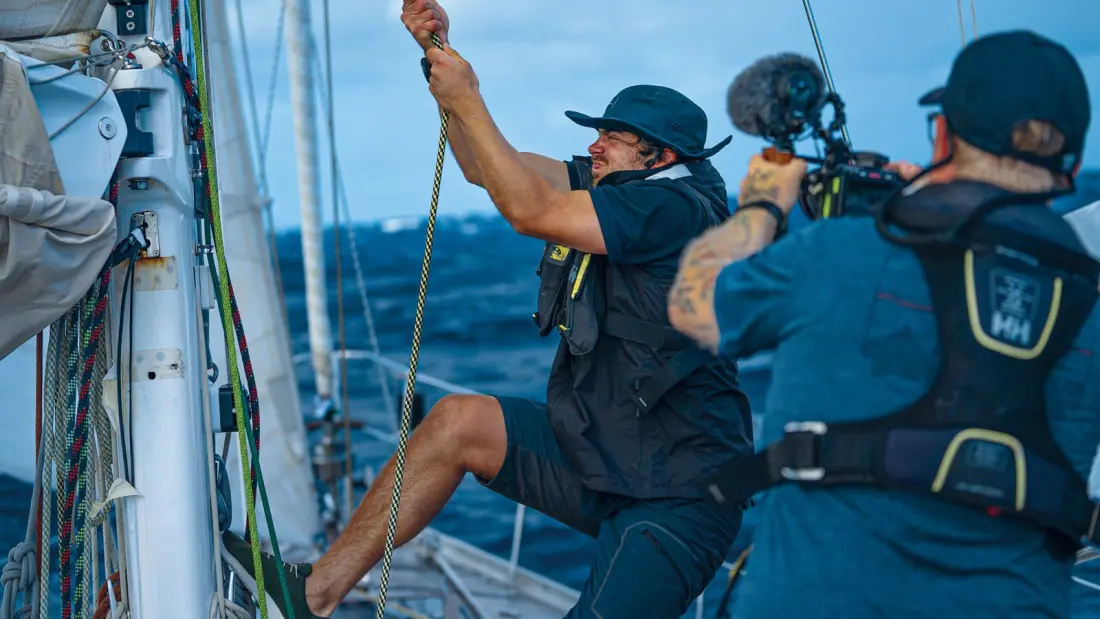
The Swedish version runs on similar principles. Skipper Gurra Krantz, a four-time Whitbread/Volvo Ocean Race veteran, initially said 'absolutely not' when producers called in 2018. Now he sails a Swan 65 extended to 70ft with a carbon mast, taking 13 people — two watch leaders, four film crew and six celebrities — on roughly 17-day crossings, Gran Canaria to Saint Martin in January, then to Salvador in August. The show avoids drama-baiting; Krantz says it's built on positive attitudes rather than controversy. Producers steer clear of anything over 35 knots of wind or 3.5m waves, though small accidents happen — the galley's tipping coffee machine is a recurring villain.
Why should a traveller care? Because these shows are a genuinely useful window into offshore passage-making, an increasingly popular holiday option via crewed charters and experience-based sailing trips. They show the reality behind the brochure: seasickness, boredom, no connectivity, the constant low-level hazard of a heeling boat. But they also show the payoff. Krantz watches novices go from wildly oversteering while staring at instruments to holding a course while telling stories, ten days in. And his simple observation about life aboard cuts deeper than any travel marketing: without a phone, you have to be 'here and now on that boat, the horizon, nothing else.' For anyone tempted to book a leg of an ocean crossing — or just wondering what a month without signal would do to them — that's the pitch.
As Krantz puts it: take a boat, put people in it, leave the dock, and things will happen.