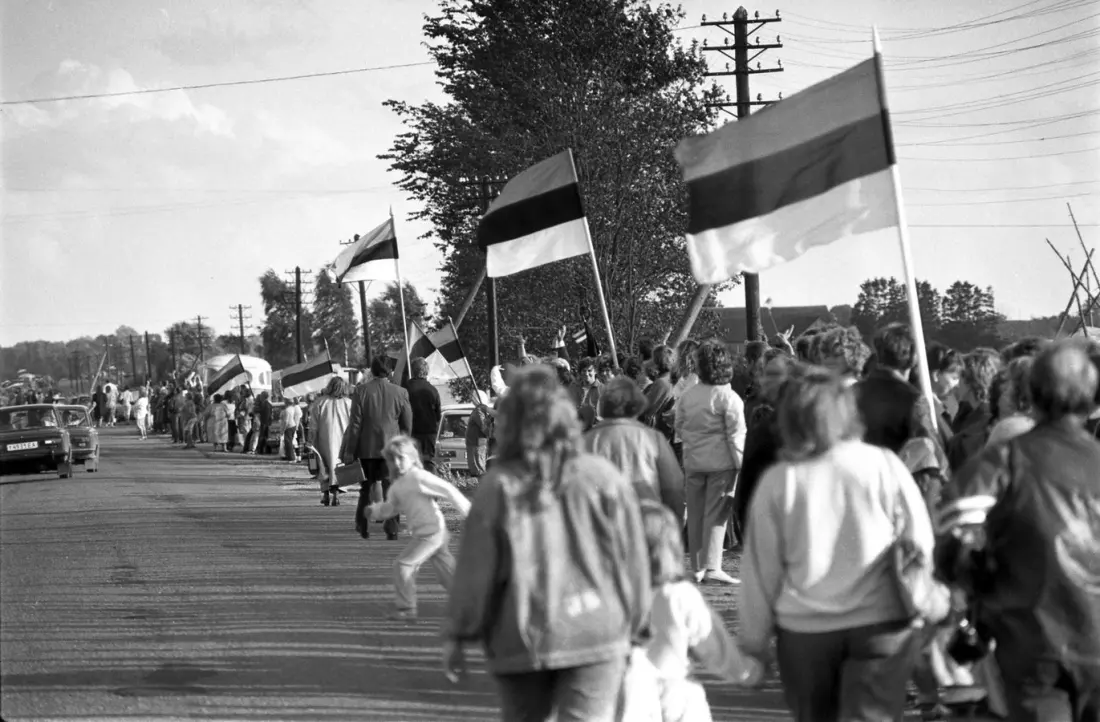
At 7pm on 23 August 1989, roughly two million people across Estonia, Latvia and Lithuania joined hands to form an unbroken human chain stretching 675 kilometres from Tallinn's Toompea hill through Riga to the foot of Vilnius' Gediminas Tower. The Baltic Way, as it became known, remains one of the longest unbroken human chains in history — and for travellers to the Baltics today, it's the single event that explains why these three countries feel the way they do: fiercely independent, European, and proud of it.
The protest marked 50 years since the Molotov-Ribbentrop Pact, the 1939 non-aggression treaty between the Soviet Union and Nazi Germany whose secret protocols carved up Finland, Estonia, Latvia, Lithuania, Poland and Romania into spheres of influence. The Soviet Union occupied Estonia and Latvia in June 1940. In 1989 there were no mobile phones — organisers coordinated the chain over six weeks using walkie-talkies, mapped assignments for every town and village, and special radio broadcasts. Participants carried portable radios to hear speeches and stay in sync.
Moscow's response was menacing. The Communist Party's Central Committee warned of "catastrophic" consequences for the Baltic peoples, and activists genuinely feared a military intervention like Hungary in 1956 or Czechoslovakia in 1968. But pressure from George H. W. Bush and Helmut Kohl helped, and in December 1989 the Soviet Congress of People's Deputies declared the secret protocols null and void. Independence followed on 20 August 1991.
The human stories are what give the event its staying power. Eight-year-old Anne-Marie Riitsaar, daughter of an Estonian father and Russian mother, mainly remembered her mother's promise that in a free country she could buy as many bananas as she wanted — a small detail that said everything about life behind the Iron Curtain. Her recollection featured in a Vabamu Museum exhibition in Tallinn, alongside tales of a girl cooking her first meal so her mother could join the chain, and another who came simply to hold hands with a boy she liked.
For visitors, this history is everywhere in the Baltics and worth seeking out. Vabamu in Tallinn explores occupation and freedom through ordinary lives; Tallinn's Old Town, Riga's Art Nouveau quarter and Vilnius' baroque centre all sit along the route the chain once traced. Historian Kaarel Piirimäe compares it to 9/11 — everyone who lived through it knows where they were. The Baltics are compact enough to follow the whole route by bus or car in about a week, and understanding the Baltic Way turns a pretty triple-city trip into something far more meaningful. It's also a reminder, as Vabamu's director Keiu Telve puts it, that freedom is fragile and needs daily care — a message that resonates strongly in this corner of Europe today.
Story via Estonian World.