
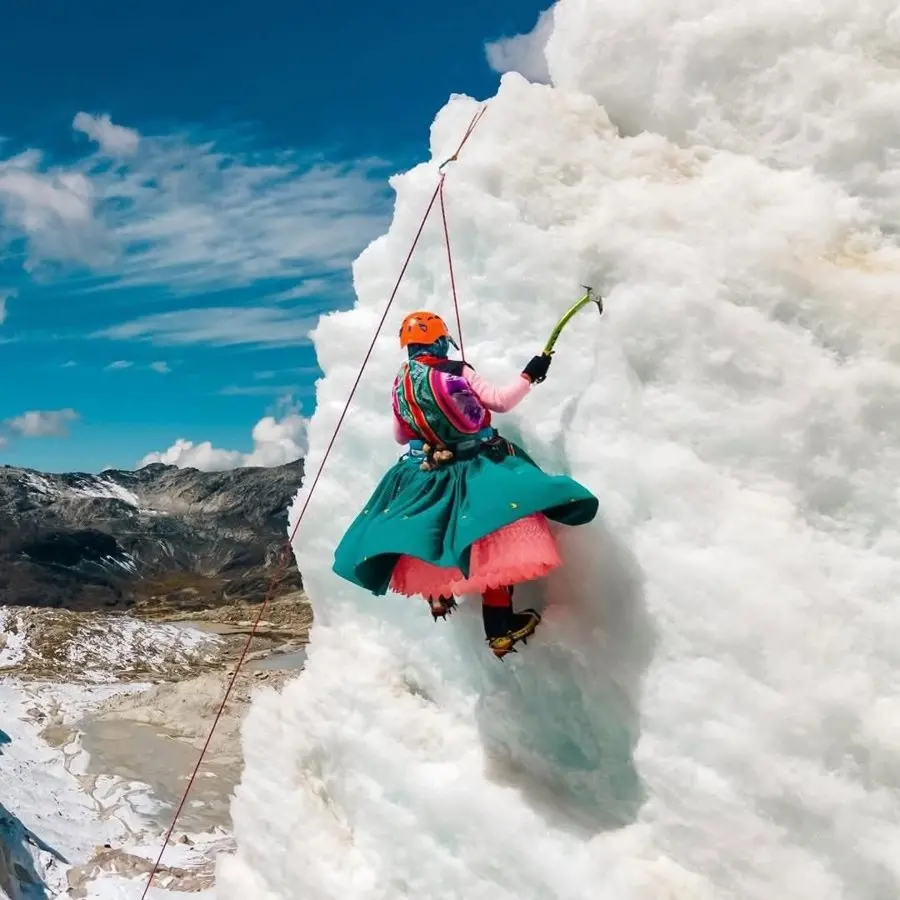
On a Bolivian mountainside, a rope team moves up the ice. Leading it are women in polleras — the bright, heavily pleated layered skirts worn by Aymara women for generations — with climbing gear slung over their shoulders in traditional woven shawls. Helmets, boots, crampons and ice axes: yes. Technical mountaineering shells: no. These are Las Cholitas Escaladoras Bolivianas, the Cholita Climbers, and they've been quietly rewriting who belongs at altitude since 2015.
The group was founded by local Aymara women, among them Cecilia Llusco Alaña, many of whom grew up working and living in the mountains — often as porters or cooks for commercial expeditions — before deciding to climb for themselves. Their landmark moment came on 23 January 2019, when they became the first Aymara women to reach the summit of Aconcagua, at 6,961 metres the highest peak in the Americas. That's a serious high-altitude achievement by any standard, made more striking by the fact that they did it in skirts and shawls rather than synthetic kit.
The choice is deliberate. The pollera is a statement of identity — a refusal to trade Aymara dress for a stereotype of what a mountaineer should look like. For decades, Indigenous women in Bolivia were excluded from professional climbing work or pushed into support roles; cholitas faced open discrimination in city life too. Seeing this team roped up on a glacier has become a powerful image, both in Bolivia and well beyond it, and photographer David Jácome's recent portraits have given the story another wave of international attention.
For travellers, the climbers are also a doorway into Bolivia's high-country culture more broadly. They're based around the Cordillera Real near La Paz and El Alto, a range stacked with peaks over 5,000 metres, and several members work as mountain guides themselves — meaning you can quite literally book an ascent with some of the most experienced women on the mountain. Even if you never strap on crampons, the wider setting rewards the trip: the cable cars over La Paz, the altiplano light, and the strong living Aymara culture that the climbers' traditional dress represents.
The story resonates with a wider shift in who gets to be the protagonist of adventure travel. Rather than an outsider's expedition with local support staff, this is a homegrown team setting records on their own ancestral terrain — and inviting the world to climb with them. If your next trip leans towards South America, the Cholita Climbers are a good reason to put Bolivia near the top of the list, and to think twice about who you hire as your guide when you get there.
Story spotted via Messy Nessy Chic.