
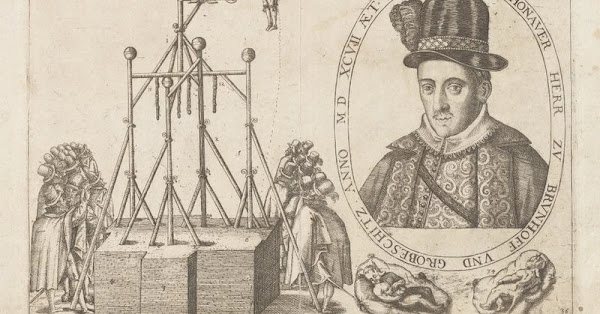
Stuttgart's grandest failed get-rich-quick scheme ended with a 12-metre gallows, gilded in mockery, built from the very iron that was supposed to have become gold.
In 1596, a 24-year-old Moravian named Georg Honauer talked his way into the service of Friedrich I, Duke of Württemberg. Born in Olomouc in 1572, Honauer presented himself as a master goldsmith and alchemist who could turn base iron into gold. The duke, like many princes of his era, took alchemy seriously as both science and occult art, and he bit hard. He converted his Stuttgart summer residence into a laboratory, added facilities at nearby Kirchheim unter Teck, and shipped in nearly two metric tons of iron from Mömpelgard for the great transmutation.
Honauer's shopping list kept growing: over 1,000 pounds of saltpetre, more than 1,800 pounds of lead, plus white copper, mountain antimony and piles of other reagents. The gold never appeared. When the duke's patience snapped, Honauer fled Stuttgart — prompting Friedrich to circulate illustrated wanted notices across the region until he was caught.
At trial, Honauer was convicted of defrauding the duke and of falsely claiming noble status. The sentence came with a theatrical flourish: the duke ordered a gallows built from the same iron Honauer had promised to transmute, rising 12 metres from a stone plinth, decorated with finial balls and hanging chains — and then gilded as a final insult. On 2 April 1597, Honauer was led to the scaffold in a lavish gold-brocade tunic and hanged before a large crowd. Printed leaflets spread the news across the duchy as a warning to other fraudsters.
It didn't work. The duke was subsequently cheated by at least three more goldmakers, each of whom ended on the same gallows. And the structure itself had a long afterlife: it stood in use for over a century, and its most famous victim was Joseph Süß Oppenheimer, financial adviser to Duke Karl Alexander, hanged there on 4 February 1738.
For travellers in Stuttgart today, this is one of those stories that makes the city's Renaissance history feel alive — a reminder that the duchy's alchemical obsession left traces in printed broadsheets (some now held by the Science History Institute) and in the lore of the region. It pairs naturally with a visit to Stuttgart's Old Castle and the Württemberg museum collections, and with a detour to Kirchheim unter Teck, whose palace once housed Honauer's lab. History buffs chasing darker chapters will also find the Oppenheimer connection resonates well beyond the region, having inspired novels and films.
It's a story about greed, gullibility and showman fraudsters — which, let's be honest, hasn't aged a day.