
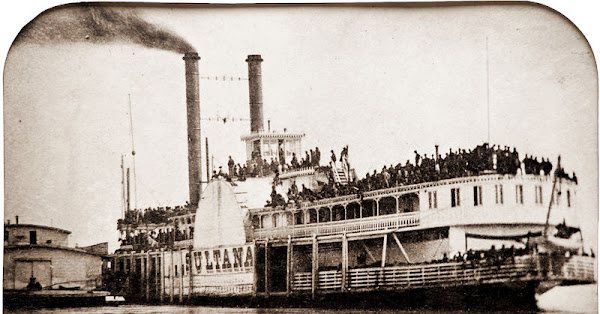
Seven miles north of Memphis, around 2 a.m. on April 27, 1865, three of the four boilers on the steamboat Sultana exploded. The side-wheeler was carrying 2,137 people — nearly six times its legal capacity of 376 passengers — and most of them were Union soldiers who had just survived the Civil War and notorious prison camps like Andersonville and Cahaba. They were finally going home. More than 1,100 of them never made it.
The Sultana was a 260-foot, three-deck steamboat built in Cincinnati in 1863, running the Mississippi between St. Louis and New Orleans. In the chaotic weeks after the war ended, Captain James Mason struck a corrupt deal with Vicksburg quartermaster Reuben Hatch: a government bounty of $2.75 per enlisted soldier, plus a kickback, in exchange for a guaranteed load of released prisoners. When one boiler sprang a leak, the chief engineer pushed through a rushed patch job instead of proper repairs that would have cost days. Meanwhile nearly 2,000 skeletal, malnourished ex-prisoners crammed aboard, their weight forcing decks to sag until crews propped them with wooden beams.
When the boilers blew, the crowded decks collapsed, the pilothouse was destroyed, and fire consumed the wooden vessel. Hundreds leapt into the dark, fast-moving spring river — men too weakened by starvation to swim. Rescue boats from Memphis saved some, but bodies washed downriver for months, some found as far away as Vicksburg. Modern research puts the toll at roughly 1,164, possibly higher.
Why did America forget? Timing. The explosion came just 12 days after Lincoln's assassination, one day after John Wilkes Booth was killed. Newspapers were saturated with mourning and manhunts, and a war-weary nation had grown numb to casualty lists. Justice also slipped away: the officer first blamed, Captain Frederic Speed, had his conviction overturned; Mason died in the disaster; Hatch fled the service and died in 1871. No one was ever held accountable.
The river itself changed course, and by the 20th century the wreck lay buried about 10 metres underground beneath an Arkansas soybean field, two miles from the Mississippi. It was located in 1982. Monuments now mark the story at Mount Olive Cemetery in Tennessee, erected by survivors in 1916, and at the Cincinnati, Vicksburg and Memphis waterfronts where the boat was built, overloaded and made her final stop.
For travellers along the Mississippi, this is a sobering thread of Civil War history worth tracing — a Memphis river walk, a Vicksburg waterfront stop, and a quiet cemetery monument that together tell a story of greed, negligence and terrible timing. It's American history that deserves more visitors than it gets.