
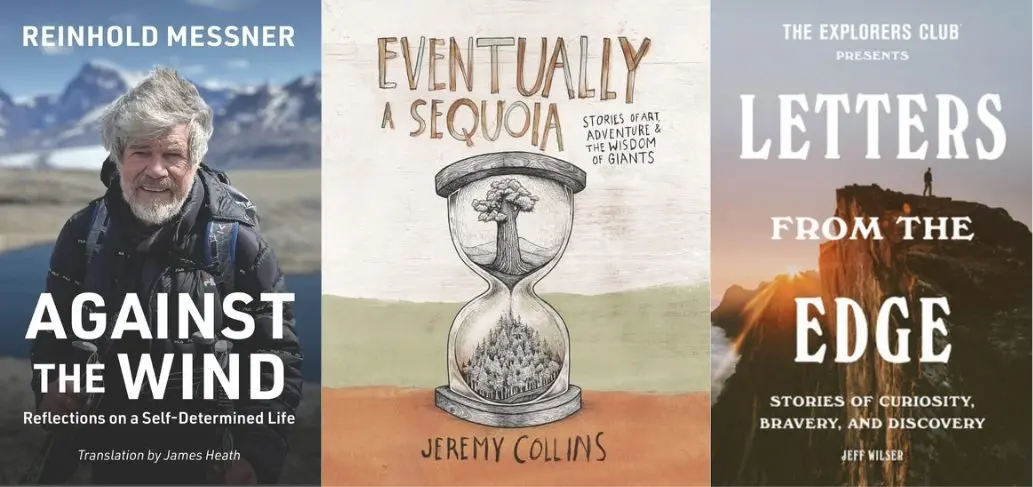
Armchair travellers have a strong start to 2026. Three new titles covered in Alpinist's spring issue take readers from the Arctic Ocean to the Peruvian Amazon, via Everest and California's granite playgrounds — no crampons required.
The most personal of the three is Against the Wind, the latest memoir from Reinhold Messner, the Italian alpinist who made the first oxygen-free ascent of Everest and became the first person to climb all fourteen 8,000-metre peaks. Now 81, Messner uses the book less as a highlight reel than as a closing argument. Yes, the summits are there, but the chapters that linger cover stranger ground: restoring Juval Castle, his long-running spats with journalists and officials, and his decades-long effort to clear his name over the 1970 death of his brother Günther on Nanga Parbat. The reviewer reads it as a man settling scores with his critics, though it ends on a softer note, walking the Dolomites with his wife Diane — and a line worth stealing: he only ever learned to take off in a headwind.
For something gentler, Jeremy Collins' Eventually a Sequoia is part memoir, part sketchbook travelogue. Collins, an artist whose drawings have run in Alpinist since 2002, set out to answer a question many creative travellers will recognise: can lines on paper actually change anything? He answers by documenting the people he's met along the way — Indigenous communities in the rainforest, villagers recovering from disasters in Nepal, campaigners defending the Arctic Refuge, and the ranching family who stewarded Indian Creek long before it became an international climbing destination. The through-line is the collision between nature and human survival, and the fact that sequoia seeds still sprout from ashes. Expect to finish it wanting to travel slower and draw more.
The broadest read is Letters from the Edge, written by Jeff Wilser with The Explorers Club. Its anchor story is remarkable: in 1923, a young Iñupiaq woman named Ada Blackjack joined an expedition to Wrangel Island in the Arctic Ocean, organised by former club president Vilhjalmur Stefansson, for fifty dollars a month — money she needed to support her son. When a ship finally arrived nearly two years later, she was the only survivor, and her diary remains the key record of what happened. Around her story, the book ranges widely: Andrés Ruzo hunting a boiling river in the Peruvian Amazon, Klaus Thymann documenting climate change in the Rwenzori Mountains while dictating voice memos to a new love interest, Paul Neil on Everest and Lhotse, and Richie Kohler diving deep. It's pitched as an exploration book rather than a climbing one, but the pull toward the edges is the same.
Any of the three would earn a spot in a luggage or on a long-haul flight — Messner for the legend, Collins for the eye, and Letters from the Edge for sheer range of places you'll want to Google mid-chapter.