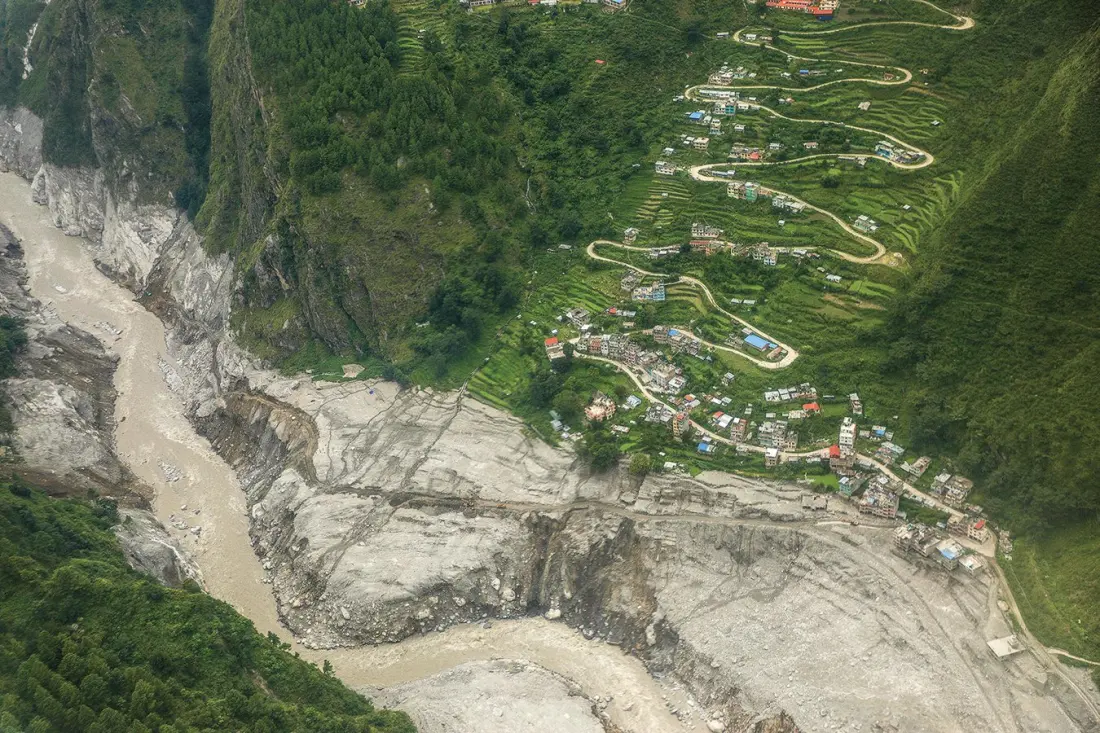
More than a month after the 26 August floods tore through Nepal's Trishuli Valley, the official death toll is expected to pass 7,000 — yet fewer than 1,500 bodies have been recovered, and only 112 of those have been identified and returned to families. For hundreds of households in Nepal and overseas, the disaster is not over; it has simply stalled.
The scale of the identification backlog is stark. Family members have submitted 2,060 DNA samples while 1,329 tissue samples have been collected from recovered bodies, but Nepal has just two government labs doing this work: the Central Forensic Science Laboratory and the National Forensic Science Laboratory. Forensic experts warn it could take six months to a year to process all the remains held in morgues and temporary burial sites in Chitwan, Gokarna, Pokhara and Nawalparasi. Some also question why the government is turning to costlier international partners when domestic facilities, such as the Centre for Molecular Dynamics Nepal, say they have spare capacity.
Ten countries, including India, China, Japan, South Korea, Singapore, Australia and the United States, have sent forensic teams and equipment — 650 people from 38 nations are still counted as missing. Even with that help, decomposition complicates matters: extracting DNA from bone and teeth takes far longer than standard soft-tissue work, and experts say earlier fingerprint matching with official records could have sped things up.
There is a legal dimension that matters as much as the forensic one. Nepal's National Civil Code 2017 normally requires a person to be missing for 12 years before they can be declared dead — but Section 40(4) already allows immediate judicial declarations of death for disaster victims. Despite that, death certificates are not being issued, which blocks families from relief payments, compensation and insurance. Children who lost both parents remain legally 'missing' rather than orphaned, cutting them off from state benefits. Lawyers are also warning about citizenship documentation for children who have lost every adult relative, arguing that failures now will create battles years down the line. The Home Ministry has drafted an amendment to streamline disaster death registration, but for waiting families it cannot come soon enough.
For anyone with ties to Nepal — including the large diaspora and travellers who know the Trishuli region's river valleys and trekking routes — this story is a reminder that recovery from major disasters is slow and administrative as well as physical. Affected districts include Rasuwa, Dhading and Nuwakot, and the ID and paperwork bottlenecks affect Nepalis and foreign nationals alike. If you are travelling in the region or have family connections there, expect ongoing relief operations, disrupted local infrastructure in the worst-hit valleys, and a national conversation about disaster preparedness that will shape how Nepal handles future emergencies.
Reported by Nepali Times