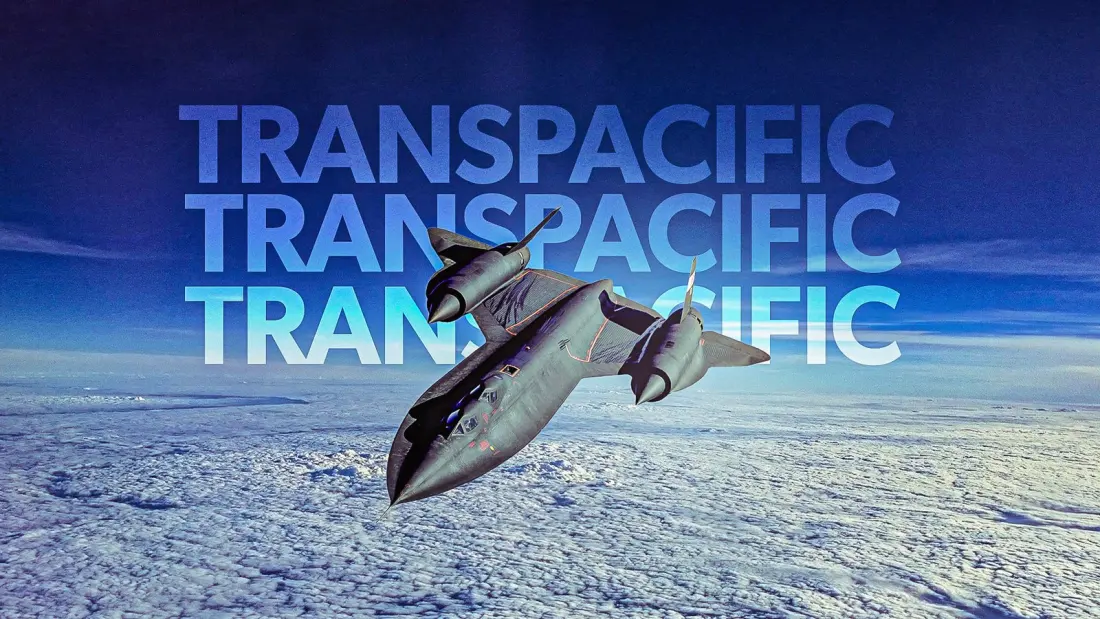
A US Air Force SR-71 Blackbird once left Okinawa on a Saturday and landed in California in time for Friday happy hour. Pilot David Peters and reconnaissance systems officer Ed Bethart departed Kadena Air Base at 10:00 AM, flew east across the Pacific, and — thanks to Mach 3 speed and a crossing of the International Date Line — touched down at Beale Air Force Base 17.5 hours before their official departure time. Peters himself confirmed it: after de-suiting and debrief, they reached the officers' club at 16:30 on the Friday before they left.
The route itself was a feat of logistics. The jet first topped up from a KC-135Q tanker over the Sea of Japan, then climbed to 80,000 feet and accelerated past Mach 3, its titanium skin glowing red-hot from friction. Peters steered toward the Korean DMZ, blasted over the Sea of Okhotsk, skirted Russia's fortified Kamchatka Peninsula, then slowed to meet a second tanker off Adak in the Aleutians before the final supersonic leg across the Pacific to California.
So why has no civilian aircraft — not even Concorde — come close? Physics and money. Concorde's aluminium airframe softened beyond Mach 2.04, capping it well below the Blackbird's 2,200 mph. In the most famous comparison, an SR-71 flew New York to London in 1 hour 54 minutes in September 1974; Concorde's fastest ever on the route was 2 hours 52 minutes. The Blackbird survived the heat thanks to Kelly Johnson's Skunk Works: an airframe that was 93% titanium (quietly sourced from the Soviet Union at the height of the Cold War), leaky expansion joints that only sealed when red-hot, and Pratt & Whitney J58 engines that morphed from turbojets into ramjets mid-flight.
But Mach 3 came at a brutal price. The fleet poured fuel onto the runway before every takeoff because the loosely fitted skin panels only sealed when heated. Out of 53,000 total flight hours, the jets spent just 22% of their time above Mach 3 — the 1968 transpacific record averaged only around 1,217 mph once climbs and refuelling were counted. By the late 1980s the twelve remaining Blackbirds cost roughly $260 million a year, about $85,000 per flight hour, with the special JP-7 fuel alone running $18,000 an hour. The Air Force retired the fleet in 1990, Congress briefly revived it with $130 million more in the mid-90s, and politics shut it down for good by 1998.
For travellers, the takeaway is simple: the airliner 'arriving before it left' — say, Tokyo at 7:45 PM landing in Los Angeles at 1:55 PM the same day — is just a calendar trick from the date line. What Peters pulled off required an aircraft that could outrun the Earth's rotation, and the world will likely never build another. Even Boom and today's supersonic startups are chasing Concorde's numbers, not the Blackbird's.