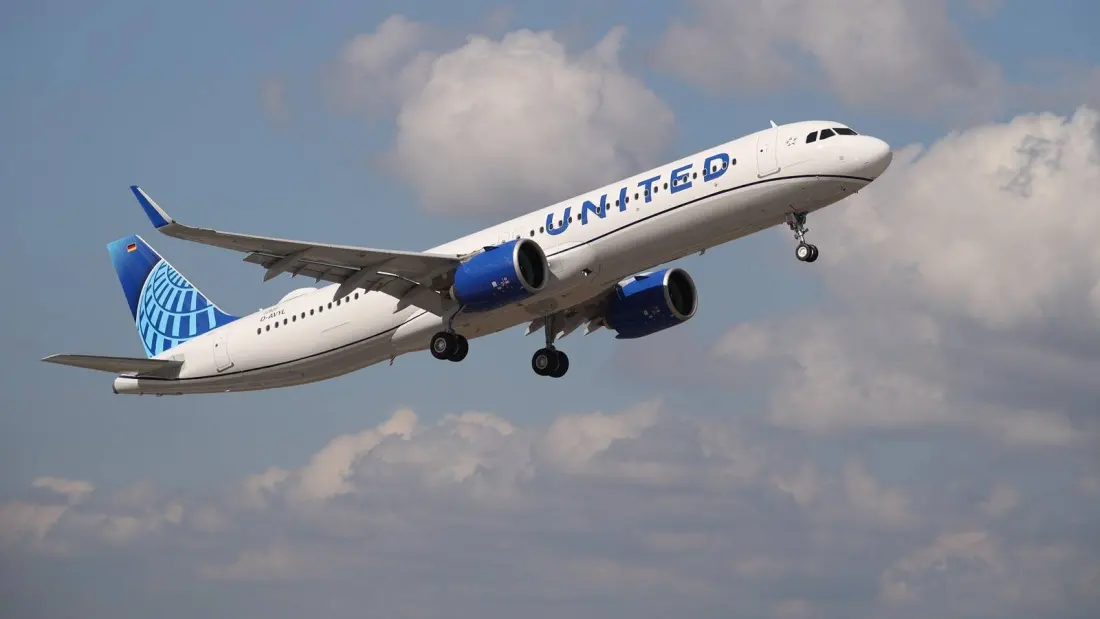
United Airlines has taken delivery of the world's first commercial aircraft powered by Pratt & Whitney's GTF Advantage engine — an Airbus A321XLR that will start life on US domestic routes before crossing the Atlantic. It's a milestone for both the airline and the engine maker, whose partnership stretches back nearly a century.
The GTF Advantage is an upgraded version of the PW1100G-JM, built for durability and performance. Pratt & Whitney says it can spend up to twice as long on the wing as previous-generation engines, deliver around 8% more takeoff thrust, and cut fuel burn. Crucially for airlines, the new engines can be mixed and matched with existing GTFs in the same fleet, though full switchover of the production line isn't expected until 2028. Air Canada will be the next carrier to receive them.
For passengers, the more interesting story is what the aircraft will do. The A321XLR is currently the only narrowbody capable of genuine long-haul flying, with legs of up to 11 hours — exactly the kind of heavy takeoffs and thermal cycles that stress-test a new engine. United's example is configured with just 150 seats: 20 Polaris suites, 12 Premium Plus seats and 118 in economy, plus Starlink wi-fi on board.
The initial schedule keeps the jet on domestic sectors from Washington Dulles — San Diego from 9 September and Los Angeles from 1 October, both through the end of November. From 1 December it goes international, with Dulles to Dublin and Amsterdam. In spring, the network widens: Newark to Luxembourg from 2 April, Dulles to Toulouse from 26 April, and from 2027, Newark to Ibiza, Valencia and Marseille. United also sees the type opening up an expanded South American network.
Strategically, the A321XLR is United's answer to a familiar problem: thin long-haul routes that don't justify a widebody. It will gradually replace the Boeing 757-200 on those routes. United currently has just two XLRs but more than 50 on order, so if you fly transatlantic or to secondary European cities in the next few years, chances are decent you'll end up on one.
Why should travellers care? Because this aircraft shape is changing the map. Narrowbody long-haul jets make it economical to fly routes like Newark–Marseille or Washington–Dublin that a widebody couldn't fill — more direct options, smaller cabins, and a lie-flat Polaris seat on planes that previously had recliners at best. If your home airport has been waiting for a nonstop to Europe, this is the aircraft that could make it happen.