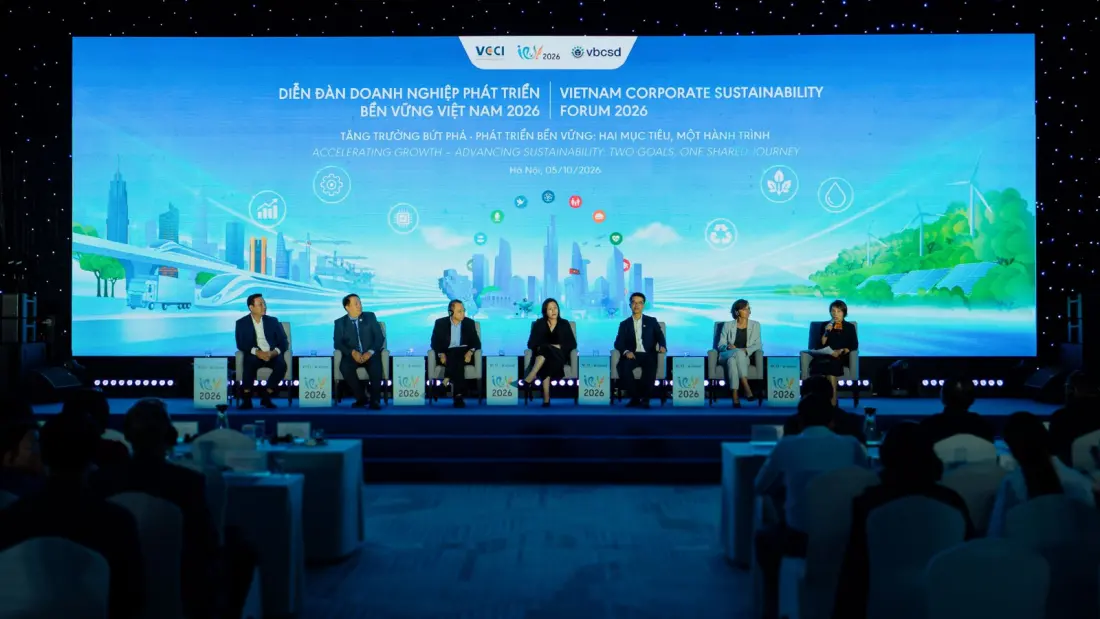
Hanoi recently hosted the Vietnam Corporate Sustainability Forum (VCSF) 2026, and the message coming out of it was blunt: Vietnamese companies can no longer compete on size alone. Nearly 30 speakers and more than 300 delegates from government ministries and major firms gathered to argue that the next phase of growth has to come from productivity, innovation and resilience — with sustainability treated as a business advantage rather than a box-ticking exercise.
The forum, backed by the Vietnam Chamber of Commerce and Industry (VCCI), collected practical feedback from companies on where implementation is stalling, particularly in clean energy, the circular economy, green finance and supplier development. Policymakers pointed to recent progress, including Decision 21, which categorises green projects, and Decision 46, which gives businesses clearer criteria for circular-economy practices and ESG management — both designed to make it easier for firms to access green financing.
The most concrete case study came from SABECO, the brewer behind Bia Saigon, 333 and Lac Viet, which runs 26 breweries nationwide. Its 2025 sustainability report makes a compelling business argument: beer output rose 3% while total energy consumption fell 6.8%. Renewable sources now cover 46.4% of energy used at its breweries, 81.4% of waste is reused or recycled, and every package in its product range is recyclable or reusable. Deputy CEO Larry Lee's takeaway was that sustainability gains come from unglamorous operational fixes — better energy use, less material waste, smarter water management — that pay off commercially as well as environmentally.
SABECO also pushed an idea that matters well beyond brewing: raising standards across a supply chain only works if big buyers help smaller suppliers get there. Rather than simply imposing environmental and social requirements on partners, the company is embedding training, management know-how and technology support into its supplier programme, with realistic timelines so smaller businesses aren't crushed by compliance costs. Lee's argument was that no single company can drive Vietnam's transition alone — it needs policy, logistics, finance and supply chains moving together.
For travellers, this is more relevant than it sounds. If you're heading to Vietnam and ordering a Saigon beer with your banh mi, the brewing behind it is increasingly powered by renewables with far less waste — part of a broader shift in how one of Southeast Asia's fastest-growing economies balances industry with its famously beautiful coastlines, deltas and mountains. It also signals to visitors that Vietnamese businesses are thinking long-term about the environment, from hospitality to food and drink.
Who's this for? Anyone tracking Vietnam as a destination, or curious how sustainability actually plays out on the ground in emerging markets — not just in hotel brochures but in factories and supply chains. The country's tourism appeal depends heavily on its natural environment, so corporate moves like these have a ripple effect on what travellers will find there in the years ahead.
Story reported by Vietnam Insider.