
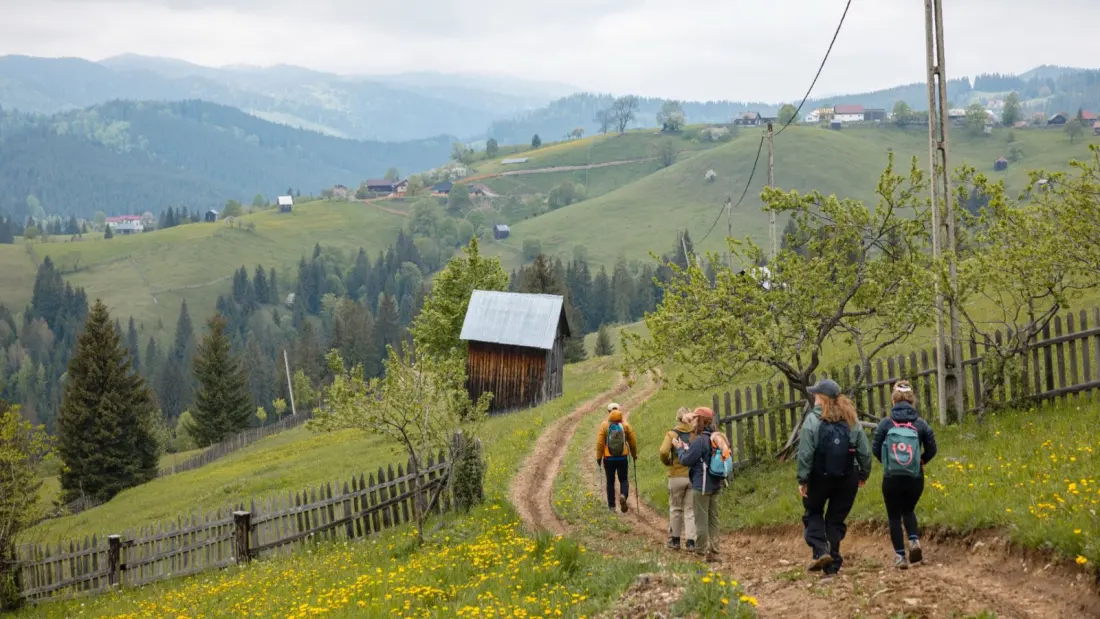
Romania's first long-distance hiking route is as much a social project as a walking trail. The Via Transilvanica, finished in 2022 after four years of work by the NGO Tasuleasa Social, runs 1,400km (870 miles) from Putna in the north to Drobeta-Turnu Severin in the southwest, with a 200km extension to Brasov. Existing paths were linked and cleared, 50 tonnes of rubbish removed, and every kilometre now marked with a hand-designed stone post — one, near Fundu Moldovei, cheekily carved as a bum in honour of the village name, which translates as the 'Bottom of Moldova'.
The founders are upfront that tourism isn't the point. Illegal logging — driven partly by the so-called 'wood mafia' — threatens the roughly 30% of Romania covered by forest, and the trail exists partly to show authorities that trees are worth more standing. Around 700 locals volunteer as 'foster parents' for sections of the route, while others earn income hosting walkers. That hospitality is the highlight of any visit: a family guesthouse serving sarmale (stuffed cabbage rolls) on a hillside terrace, a father-and-son stop near Vatra Dornei that grew from a single water tap into a wooden guesthouse now hosting about 1,500 guests a year, and Cabana Gigi Ursu, opened in 1977 and busier than ever thanks to hikers.
The hiking itself, at least in the Bucovina sections, is pleasantly undulating through conifer forest, hay meadows and open ridgelines with layers of peaks and barely another soul around. Romania holds Europe's largest populations of bears, wolves and lynx outside Russia, but guides will tell you not to expect sightings — the animals hear you long before you see them. Expect cuckoos, roe deer prints and, on misty mornings, folk tales about the fairies and spirits said to live in these woods.
Bucovina's cultural rewards are just as strong. The region's painted monasteries at Sucevita and Moldovita, both built in the 16th century, are part of the Churches of Moldavia World Heritage Site, their walls and facades covered in frescoes — some faded by centuries of weather, some scarred with scratched-out Germanic names from Habsburg times. In Moldovita village, women like Viorica Semeniuc still practise a 17th-century batik egg-painting tradition, layering beeswax and dye to produce geometric designs in black, white, yellow and red.
For travellers, the appeal is a slow, well-marked route where your money goes straight into small villages rather than resorts. You can walk short sections day by day, eat home-cooked food, and meet the people maintaining the trail — a rare case where a hiking route and community revival are the same project.