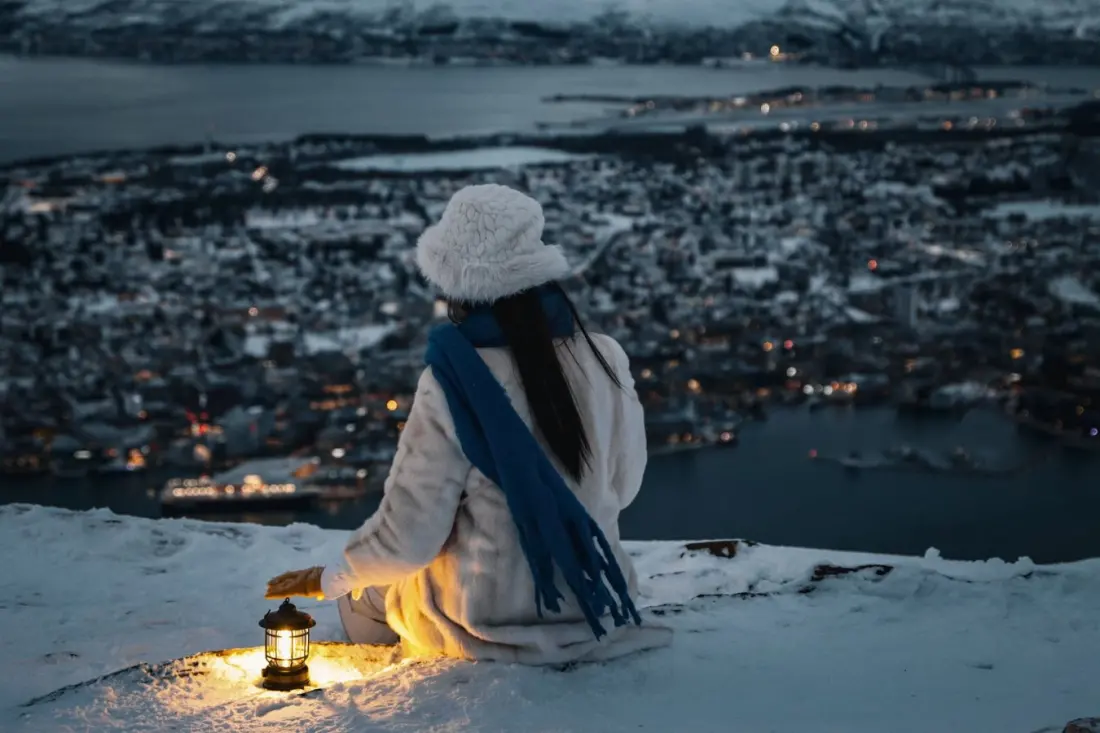
In Tromsø, at about 69° north, the sun stays below the horizon from roughly mid-November to mid-January. When Kari Leibowitz, then a Stanford social-psychology researcher, arrived on a ten-month Fulbright stay expecting to study how residents endured the polar night, she found something she didn't expect: people talking about winter as something they looked forward to. Skiing, snow, the soft blue midday twilight, cosy rooms and time with friends — the season came with its own gifts, not just its difficulties.
That observation became a study with University of Tromsø psychologist Joar Vittersø. Since no questionnaire existed for measuring how people relate to winter, they built one: a ten-statement Wintertime Mindset Scale mixing positive items (winter is beautiful, cosy, full of activities you can't do otherwise) with negative ones (feeling tired, depressed, unmotivated). On 5 January 2015 they mailed invitations to 1,500 randomly selected addresses — 500 each in Oslo, Troms county and Svalbard — and 238 people responded during late January, catching the tail of the polar night.
The headline finding is strikingly geographical: wintertime mindset scores rose with latitude. Oslo averaged 3.34 out of five, Troms county 3.58 and Svalbard 4.01 — the Arctic archipelago scored significantly above both southern locations. Intriguingly, wellbeing itself didn't climb northward. Life satisfaction and mood were statistically similar across all three regions. The link was indirect: people farther north held warmer attitudes toward winter, and those warmer attitudes travelled with greater life satisfaction, more positive emotion and higher flourishing.
The researchers were careful about what this doesn't prove. It was a one-time survey, not an experiment, so causation is unclear — perhaps expecting good things from winter leads people outdoors and into company, or perhaps contented people simply interpret darkness generously. Svalbard has an obvious self-selection problem: people who move to Longyearbyen choose the extremes. And the authors explicitly warned against reading the work as advice to snap out of seasonal depression, which they never measured. Mindset, they suggest, is partly communal — easier to find winter beautiful where infrastructure, clothing, work rhythms and social invitations are all built around the season.
For travellers, the takeaway is genuinely practical. Winter in the far north is not a gauntlet to be survived between northern-lights sightings; the locals treat it as the main event. Time a trip to Tromsø for the polar night itself and you'll find a city organised around twilight — ski trails, candlelit cafés, whale-watching boats and a social calendar that doesn't hibernate. Pack properly, plan around the two-to-five hours of civil twilight, and borrow the local framing: the darkness holds several experiences at once, and the pleasant ones are easier to find if you arrive expecting them.