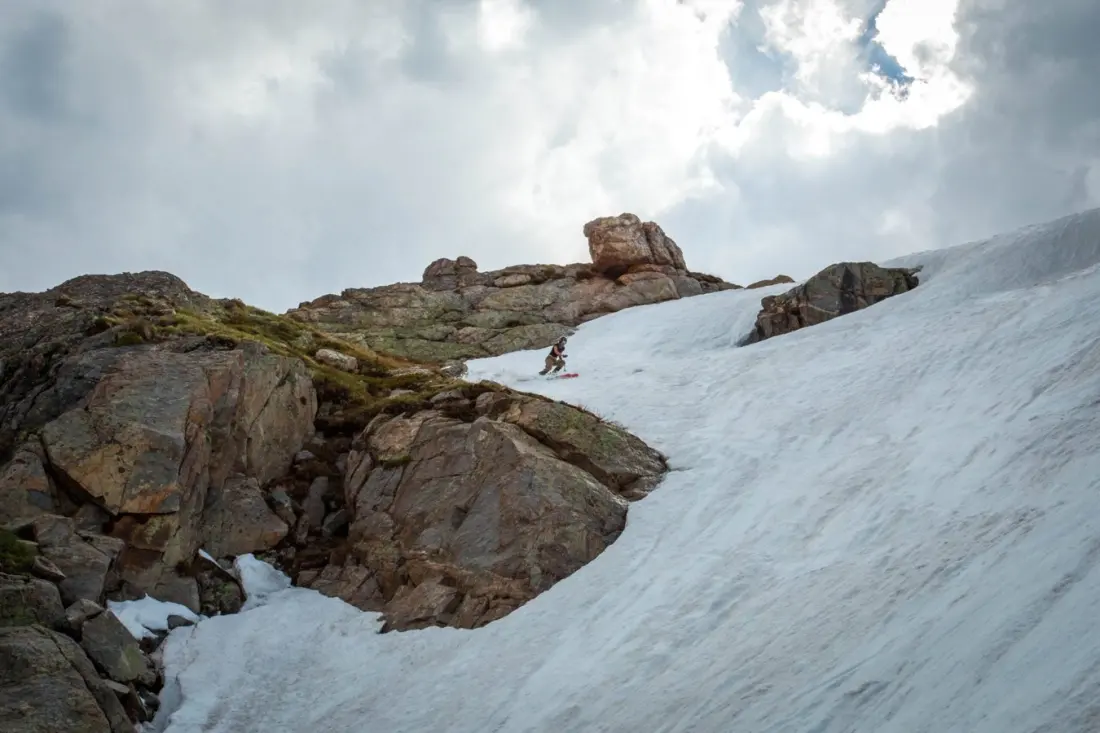
For decades, skiers in Colorado had a summer fix: St. Mary's Glacier, a patch of permanent snow near Idaho Springs where you could hike up and earn turns in June, July, even August. As of August 2026, it's gone. The glacier has melted out entirely, ending a run that made it one of the most accessible summer snow venues in the Rockies.
The loss hits harder because of what the place meant. In summer 2020, as pandemic restrictions eased, two former SKI Magazine staffers drove 75 minutes from Boulder up through Clear Creek Canyon to ski it. They found a packed lot, families picnicking around a turquoise proglacial lake, hammocks strung in the trees, and a steady stream of hikers and skiers climbing through thin woods toward the snowfield sitting above 10,000 feet.
The skiing itself was classic summer corn: wet, sun-softened snow that still slid cleanly underfoot, best in the late afternoon when shadows firmed up a chute at the top of the run. On that June day the pair crossed paths with a Connecticut transplant logging his 100th day of the season on snow — the kind of person St. Mary's attracted. It wasn't a resort. It was a free, scrappy hike-in spot where anyone with boots and a sense of humour could ski in shorts under an 80-degree sun.
Its disappearance is part of a broader pattern, with once-reliable year-round snowfields across the West fading as summers warm. For skiers, it removes one of the easiest places in the country to sample backcountry-style touring — a short, non-technical approach that made it a common first step beyond the lifts.
The story also carries a safety note worth repeating. Summer snow hides hazards that winter conditions make obvious, and the original writers urged anyone heading into softened snow to stay well within their limits and avoid taxing mountain rescue teams — a reminder that applies wherever the remaining summer snowpatches still hold.
For travellers who love mountains, St. Mary's is a reason to go now rather than later. Nearby winter ski areas, Rocky Mountain National Park and the high basins around Colorado's Front Range still offer alpine experiences, but anything advertised as a "glacier" hike deserves a fresh check on current conditions before you go.