Paula Pugh flew into Reggio Calabria in southern Italy to celebrate her husband's 60th birthday. Instead, she ended up interrogated at passport control, driven to another airport in a police vehicle and put on a flight back to London, her passport confiscated by the captain for the trip. Her alleged crime: overstaying Europe's 90-day Schengen limit. The actual problem: the EU's new Entry-Exit System had failed to record an earlier exit from the zone, so the database wrongly showed her as a continuous visitor.
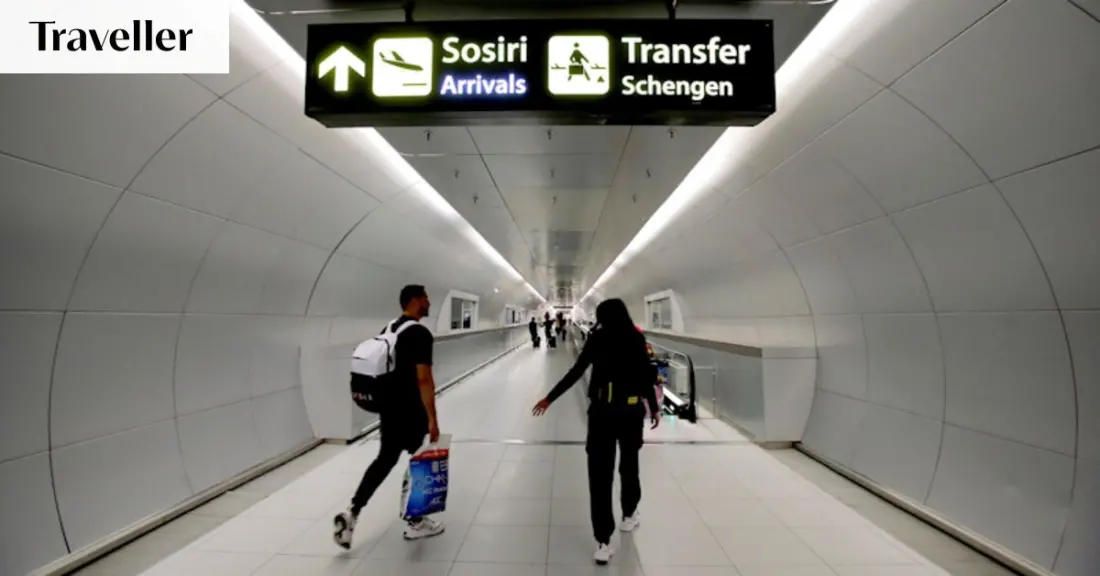
The EES is the digital border regime that is slowly replacing the humble passport stamp across the Schengen Area. On a first entry, non-EU travellers have fingerprints and a facial scan captured at self-service kiosks; after that, passports are scanned at e-gates and the system tracks every entry and exit automatically. The idea is to automate the 90/180-day rule — the rule allowing Australians, Brits and other non-EU nationals up to 90 days in the zone in any rolling 180-day window.
The rollout has been rough. The system was meant to be fully live at all external borders by April 10, but kiosks couldn't handle demand, biometric scans glitched and fingerprint registration failed for some passengers. IATA warned of queues up to six hours at peak times; some travellers missed connections and were advised to bring food and water. Officials responded with emergency flexibility, letting individual countries suspend biometric checks during busy arrivals. France, Italy, Germany, Spain's neighbours Belgium and the Netherlands, plus Greece, Malta, Portugal and Switzerland got informal approval to pause EES processing, and airline and travel trade groups are pushing for the suspension to last through the northern winter. The EC's own flexibility measures had been due to end September 6 — no new deadline has been set.
Not everything is chaos. At Rome's Fiumicino, average border processing has risen from roughly seven to twenty minutes — slower, but workable, and the majority of arrivals have passed through without drama. The worst scenes were confined to major hubs at peak times.
For travellers from outside the EU, the deeper lesson is that the passport stamp's safety net is disappearing. If the database records an entry but not your exit, proving you left on time is suddenly your problem. Border officials have discretion — documented illness, natural disasters or cancelled flights can soften the outcome — but an overstay can still mean a fine, a black mark on your file, an entry ban or deportation.
Until the system is genuinely reliable, two habits are worth adopting. First, run your own numbers with the European Commission's Short Stay Calculator rather than trusting the EES to do it — the rolling 180-day window is recalculated daily, and days expire individually, which trips up a lot of people. Second, keep every boarding pass and booking confirmation for entries and exits. In a database dispute, that paper trail is your defence.
Who this matters for: anyone from Australia, Britain or elsewhere outside the Schengen zone planning a multi-stop European trip longer than a couple of weeks, or two trips to Europe inside six months. The rules haven't changed — but the way they're enforced just got riskier.
Reporting: Traveller (Sydney Morning Herald)