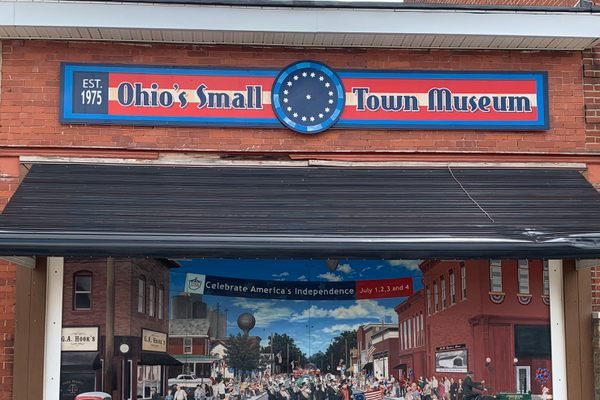
In the village of Ashville, Ohio — a once-booming railroad town in rural Pickaway County — a four-room museum occupies the old Dreamland Theater, a silent movie house that closed because its owner couldn't afford sound equipment. Today the building is packed floor to ceiling with local history, and its star attraction is genuinely strange: Teddy Boor's massive motorized traffic light, a sci-fi-looking orb that hung over the intersection of Long and Main streets from 1932 to 1982 and holds the Guinness record for the longest traffic light in operation.
The museum came out of hard times. By 1975 the depot had shut, the newspaper was gone, industry had left, and a University of Cincinnati study ranked Ashville among the lowest in Ohio for community identity. So a group of locals set out to preserve whatever social history remained — and the result is one of the most characterful small museums you'll find anywhere.
That history stretches further than you'd expect for a town of this size. There's a corner devoted to Vivian Michael, who made the area a puppetry hub in the 1950s and '60s; a New York Times bestselling cookbook by Florence Brobeck, famous for her turtle soup; records by early-1900s chart-topper Corinne Welsh; and a nod to the "Bourbon Cowboy" himself, Jack Fox. Even John Holmes, born in nearby Millersport, gets a mention. If someone had any link to Ashville, they're on a wall here.
The charm comes from the oddities, too: testimonials about a headless ghost at the train tracks, theories about Vikings near the Snake Den Mound, UFO sightings, and a taxidermied rooster that supposedly carried a dime to the town diner to pay for its feed.
Just as notable is what the museum doesn't hide. Ashville confronts its past as a former "sundown town" by displaying a Ku Klux Klan robe — while noting that by 1935 the exclusionary rules had been dropped and the town had elected Harry Margulis, a Jewish lawyer from Columbus, as mayor. It's a rare example of a small institution acknowledging the uglier chapters of local history rather than papering over them.
Practicalities are suitably low-key: retired postman John Swingle, a volunteer, typically minds the door, and you may need to knock to get his attention. Visitors are encouraged to call ahead about hours, sign the guestbook, and leave a five-dollar donation. Pair your visit with a free copy of local historian Bob Hines' book Amazing Ashville — the exhibits are cross-referenced with its pages.
Who's this for? Road-trippers who love the weird and hyperlocal, history buffs who want the unfiltered version of small-town America, and anyone who believes a five-dollar donation and a knock on the door is a fair price for a Guinness record and a ghost story. Institutions like this run on volunteers and donations, so a visit — and that contribution — genuinely keeps the lights on.